Your Expert Advisor has an impressive backtest. Then you run the same settings on a later period and the result turns negative. Should you keep changing the settings until the second chart looks better?
That temptation is exactly why a forward test needs rules. An Expert Advisor, or EA, is an automated trading program. A historical forward test checks selected settings on a later slice of historical data. It helps you ask whether the result survives beyond the data used to choose it.
This article offers a practical review process. Every trade count and cash result below is hypothetical. No EA was tested for this article, and none of the numbers represents a product’s performance.
Separate choosing from checking
Optimization means searching for settings that score well under a chosen criterion, such as net profit or a risk measure. The data used for that search is the training, or in-sample, period. A reserved checking period is often called out-of-sample.
The MetaTrader 5 optimization guide describes a built-in Forward option that reserves the latest part of the selected historical period. It offers fractional splits and a custom start date. The platform optimizes on the earlier part and runs selected results on the later part.
This is still historical simulation. It is different from watching a demo account trade as new prices arrive. Call each exercise by its actual name so a historical report does not accidentally sound like a live trading record.
Freeze a small test plan first
Before opening the reserved results, save the EA version, parameter ranges, ranking criterion, data source, symbol, account currency, position size and costs. State how you will handle trades that remain open at a period boundary. Otherwise, two apparently identical tests may be answering different questions.
For a hypothetical 24-month study, you might use the first 18 months to choose settings and reserve the last six months for checking. This is an organizational example, not a claim that a particular split is statistically sufficient.
Choose your decision rule in advance. For illustration, suppose the rule rejects a candidate with a negative average net result per completed trade in the reserved period. That is one possible screening rule, not an industry standard or proof of safety. A serious review also needs a separate drawdown limit and an explanation of the trade sample.
Read one hypothetical result honestly
Imagine one selected configuration trades EUR/USD at a fixed size throughout each test. Assume a USD account, no deposits or withdrawals, and cash results that already include spread effects, commission and financing.
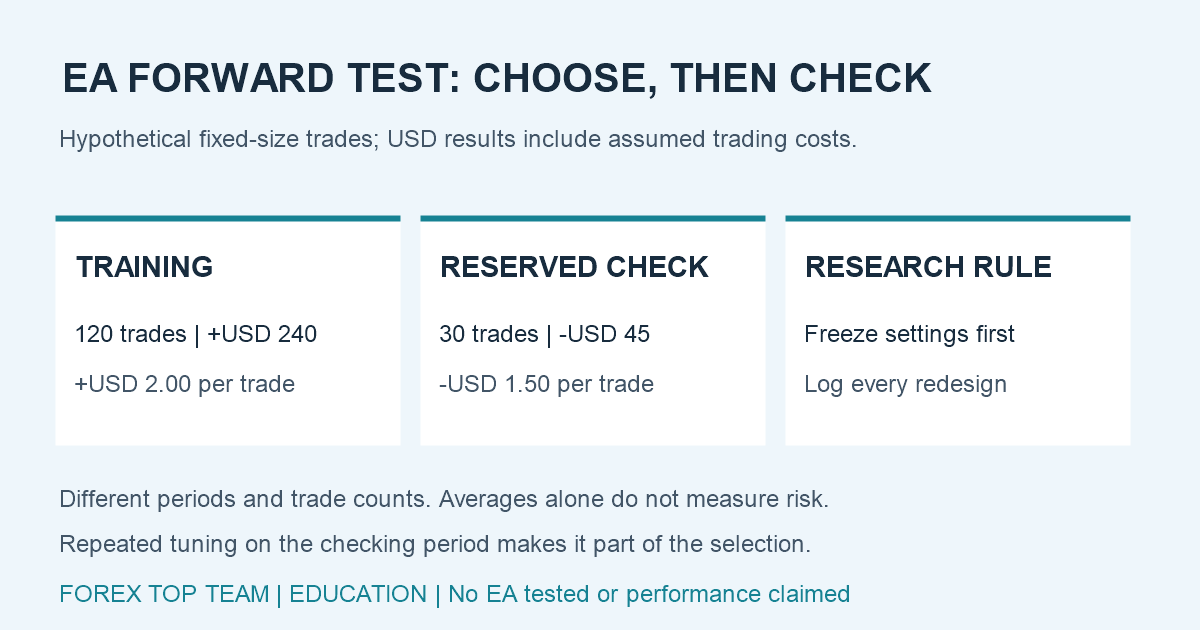
- Training period: 120 completed trades and net profit of USD 240.
- Reserved period: 30 completed trades and net loss of USD 45.
The average net results are USD 240 ÷ 120 = USD 2.00 per trade in training and -USD 45 ÷ 30 = -USD 1.50 per trade in the reserved period.
Under the hypothetical rule, this candidate fails the screening check. That does not prove that the underlying idea can never work. It means this result does not meet the rule you committed to before seeing it.
The two periods have different lengths and trade counts, so their total profits should not be treated as directly comparable performance rates. Even the per-trade averages do not describe uncertainty, exposure or the size of the worst losses. Thirty trades provide a limited view; they do not establish a stable expected return.
Notice when checking becomes another search
If you inspect the reserved loss, change the stop distance and rerun the same six months, you have used those months to make a design decision. Keep the result, but stop describing that period as untouched evidence for the redesigned strategy.
The research paper The Probability of Backtest Overfitting, by Bailey and co-authors, examines how searching many configurations can produce misleading historical winners. Overfitting means adapting too closely to the particular history rather than finding a result that carries over. The paper also discusses limitations of simple holdout methods.
The practical lesson is to log the search, including disappointing attempts. A report showing only the final attractive configuration hides information about how it was selected. This article does not calculate the paper’s probability measure or claim that one split solves the selection problem.
Keep the execution assumptions visible
The official Strategy Tester documentation explains historical testing settings, saved parameter sets and simulated execution delays. It also notes that insufficient history for initialization can shift the test’s starting date, with a message in the journal. Check the actual dates and journal instead of relying only on what you intended to select.
A reserved period does not repair missing costs or unrealistic fills. Compare results under clearly documented execution assumptions. Our EA trading-cost stress test guide shows how to review that separate source of fragility.
If you use the built-in forward optimizer, remember that it can evaluate multiple selected configurations. Sorting that forward table and choosing its winner is another selection step. Record it. A platform tab named Forward Results is not, by itself, evidence that the whole research process remained independent.
Build evidence without promising certainty
A useful next exercise is a preplanned walk-forward review: move the training and checking windows through time while keeping the selection procedure fixed. Report the later checking segments, their differences and their combined chronology. Do not search for the window schedule that produces the prettiest result and then present it as an independent test.
Further monitored demo observation can reveal operational problems, but demo fills and future market conditions can differ from live experience. Neither an attractive historical check nor a smooth demo period guarantees future profit.
Your forward-test checklist
- Save the version, parameters, dates, data and cost assumptions before reviewing the reserved period.
- Define the selection process and rejection criteria in advance.
- Record trade count, net result, equity drawdown and unusual individual trades.
- Log every redesign and every time you consult the checking data.
- Explain the limitations alongside the result, including what has not been tested.
Start with one reproducible comparison and a plain-English decision. If the reserved result disappoints, document the reason before redesigning anything. Next, study whether the EA depends on a narrow range of settings. The goal is a review another trader can understand and repeat, with uncertainty left visible.