You held a currency trade for only a few minutes, yet the overnight charge looks like several days of financing. Is that an error? Before disputing it, check which settlement dates your position crossed.
Understanding rollover helps you budget a swing trade and review an Expert Advisor, or EA, that holds positions overnight. The useful question is not just how long a trade stayed open. It is which financing rules applied while it was open.
This is an educational guide, not a report of today’s swap rates. Every price, rate and cash amount in the worked example is hypothetical.
Why Wednesday can carry three days
Rollover means carrying an open position into the next trading day. In its US financing explanation, OANDA describes a 5 p.m. Eastern Time cutoff. Its typical Wednesday adjustment moves settlement from Friday to Monday, covering three calendar days. Holidays and instrument differences can alter that schedule.
That is one provider’s policy, not a universal clock for every broker. Confirm the rules for your legal entity, account and currency pair. A calendar label such as Wednesday is incomplete unless you also know the relevant time zone.
Think of the adjustment as a calendar crossing rather than a stopwatch. A short holding period across the cutoff can therefore produce a larger charge than a longer trade closed before it. The account statement should let you reconcile the event.
Read the units before doing the math
A swap number on a trading platform is not automatically a percentage or a dollar amount. MetaTrader 5’s official symbol specification guide describes different calculation methods, separate long and short values, and daily multipliers. Open the symbol’s Specification from Market Watch and identify those fields before estimating a cost.
Write down five items: position size, calculation method, long or short rate, applicable day multiplier, and account currency. Add the broker’s cutoff time and the date when you checked. This short record makes later comparisons much easier than remembering a number from a screenshot.
Do not assume a platform point equals a conventional pip. If a specification uses points, first establish the symbol’s point size and the cash conversion for your volume. A formula for an annual percentage rate cannot simply be reused for a points-based swap.
A hypothetical charge, step by step
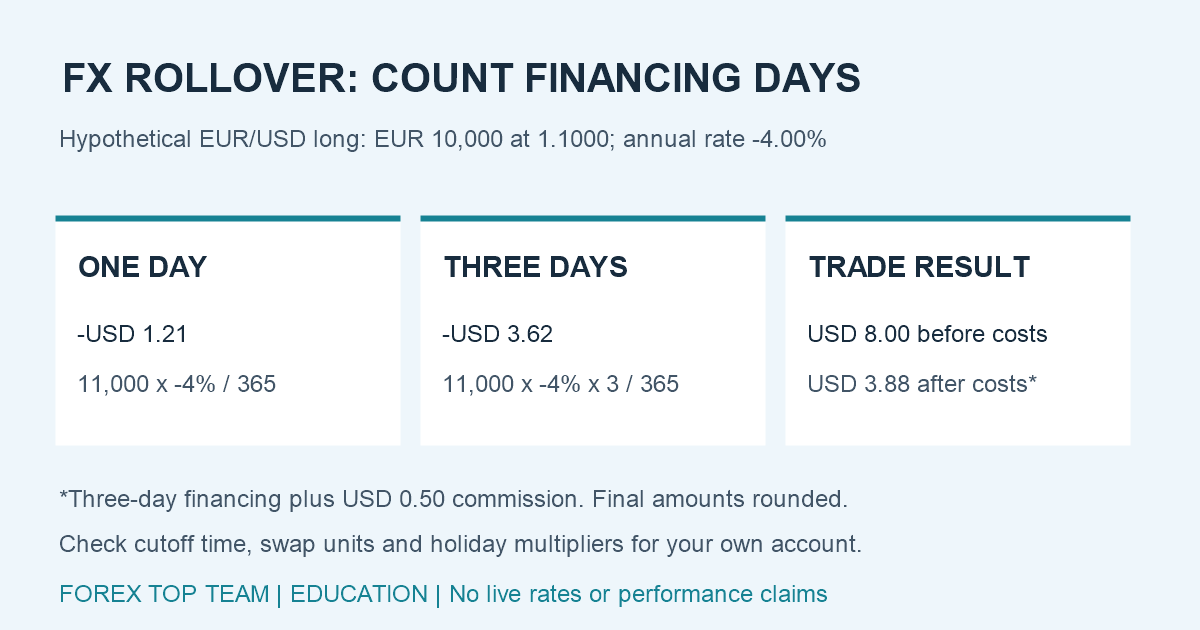
Consider a USD account with a long position of 10,000 euros in EUR/USD. Assume the rollover valuation price is 1.1000 US dollars per euro, the annual financing rate is minus 4.00%, and the calculation uses actual financing days divided by 365. These are invented inputs, not current quotes or a broker recommendation.
The USD position value is 10,000 EUR multiplied by 1.1000 USD per EUR, which equals USD 11,000. Under this assumed model:
Financing adjustment = USD position value × annual rate × financing days ÷ 365.
One financing day gives 11,000 × (-0.04) ÷ 365 = approximately minus USD 1.21. Three days give 11,000 × (-0.04) × 3 ÷ 365 = approximately minus USD 3.62. Round the final calculation, rather than multiplying an already rounded daily figure.
At this position size, a conventional EUR/USD pip of 0.0001 USD per euro is worth USD 1. The three-day charge therefore equals about 3.62 pips. That conversion helps compare financing with a price objective without pretending the charge is a market move.
Put financing beside the trade’s other costs
Suppose the same hypothetical trade earns USD 8 from the difference between its actual entry and exit fills, before financing and a separate USD 0.50 commission. After the three-day adjustment, the result is 8 – 3.6164 – 0.50 = about USD 3.88.
Here the fill-to-fill result already reflects the spread paid through those prices, so we do not subtract another spread estimate. This small example shows why a price move in your favor can leave a much smaller net result. It does not estimate an expected return or suggest that every overnight trade is unattractive.
For a trading plan, compare the financing budget with the whole trade thesis. Closing and reopening purely to avoid a charge introduces another execution decision; it is not a free accounting shortcut.
Give an EA a financing audit
For automated trading, MetaQuotes’ guide to swap properties identifies SYMBOL_SWAP_MODE, SYMBOL_SWAP_LONG, SYMBOL_SWAP_SHORT and SYMBOL_SWAP_ROLLOVER3DAYS. These help a program inspect the configured method, directional values and triple-rollover day.
Those properties are a starting point for a check, not a complete historical financing database. In your test notes, distinguish rates observed now from rates actually documented for past trades. If historical charges are unavailable, label any reconstructed series as an assumption.
Compare trades that crossed rollover with those that did not. Record holding duration, number of financing days and the resulting cash adjustment. Then run a clearly labeled adverse-cost scenario without quietly retuning the strategy to rescue its best result. Our EA trading-cost stress test guide explains how to keep that comparison reproducible.
Three misunderstandings to avoid
Three days does not mean three trading sessions. The multiplier can reflect non-trading calendar days. A positive swap is not a profitable trade. Financing credit does not remove price risk. A quoted rate is not a permanent promise. Recheck the applicable specification instead of carrying an old estimate indefinitely.
A practical check before the next rollover
- Confirm the pair, direction, account currency and calculation units.
- Check the broker’s cutoff, time zone, holiday adjustments and day multiplier.
- Estimate the cash adjustment using explicitly dated inputs.
- Afterward, compare the estimate with the posted transaction and investigate differences.
The next useful step is to audit one completed overnight trade from your own journal. Separate price profit, commission and financing, then explain each amount in plain English. After that, study how execution costs interact with holding time: a strategy needs room for both, and neither a low financing charge nor a clean backtest guarantees future profitability.