You buy a currency call, the pair rises, and the option is worth less than you paid. How can that happen? Your directional view may have worked, but an option also prices time and uncertainty. Understanding those extra moving parts helps you judge whether an option actually fits your trade idea.
This guide uses a hypothetical EUR/USD example to separate direction, time decay and volatility repricing. It reports no live option quotes or market positioning. The aim is to build a better trade review, rather than to suggest a particular contract.
Start with what you are buying
A vanilla call gives its buyer the right to buy the underlying at an agreed price, called the strike, subject to the contract’s exercise and settlement rules. A EUR call/USD put expresses the right to buy euros against dollars. Check the actual product: an option on a currency futures contract is different from a spot-referenced currency option.
The premium is the price you pay for that right. CME Group’s long-call scenarios explain why underlying price, interest rates, time and implied volatility can all affect premium. A rising underlying is only part of the story.
Before expiry, selling an option means selling its remaining value at an executable bid. At expiry, its payoff follows the contract rules. Neither result is simply the percentage change shown on your spot chart.
Three sensitivities worth knowing
Delta measures how much premium is expected to change for a small change in the underlying, with other inputs held fixed. A positive delta helps a long call when its underlying rises.
Theta describes sensitivity to the passage of time. For the ordinary long call in our example, its negative value represents an estimated daily loss from time passing, assuming the other inputs stay unchanged.
Vega measures sensitivity to implied volatility, the volatility input consistent with the option price under a model. A conventional long call has positive vega: lower implied volatility can reduce its premium.
CME’s lesson on premium and the Greeks emphasizes that these sensitivities change together. Treat them as local estimates, not fixed coefficients that work for every price move and every holding period.
A correct direction, but a negative result
Here is a deliberately simplified, hypothetical scenario for a spot-referenced EUR call/USD put. Premium is expressed in US dollars per euro of notional, not as a quoted percentage or a futures contract price. One EUR/USD pip is assumed to be 0.0001.
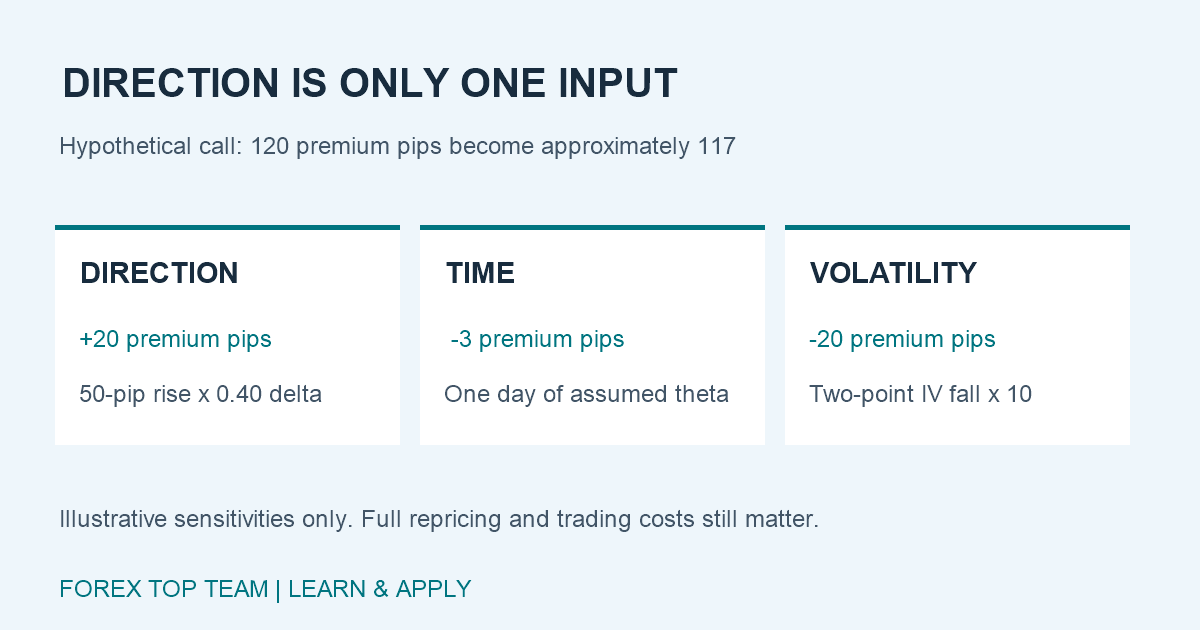
- EUR/USD rises from 1.1000 to 1.1050: a 50-pip increase.
- Initial premium is 0.0120 USD per EUR: 120 premium pips.
- Starting delta is 0.40: estimated directional contribution is +20 premium pips.
- One day passes with assumed theta of -3 premium pips per day.
- Implied volatility falls from 10% to 8%, with assumed vega of 10 premium pips per one percentage-point change.
The volatility contribution is -20 premium pips. A fall from 10% to 8% is two percentage points, which is the unit our vega uses. It is also a 20% relative decline, but multiplying this vega by 20 would use the wrong units.
The approximate premium change is +20 – 3 – 20 = -3 pips. Estimated premium becomes 117 pips, or 0.0117 USD per EUR. On a hypothetical EUR 10,000 notional, that is $117 versus the original $120: a $3 modeled loss before spreads and fees, despite the favorable currency move.
This is sensitivity arithmetic, not a complete option valuation. Gamma, which describes changing delta, and other nonlinear effects are omitted. For a real trade, reprice the entire contract under each scenario rather than assuming this estimate is an executable quote.
Why event timing matters
Imagine buying before a policy announcement because you expect the euro to rise. The market may already attach a substantial premium to uncertainty around that announcement. After it passes, that uncertainty can shrink even if the currency moves in your favor.
That creates two separate questions: did your direction call work, and was the move large and fast enough relative to what the option cost? A small rally does not answer the second question.
There is no universal rule that volatility must fall after every event. Another risk can emerge, the result can be unusually uncertain, or the broader market can become more volatile. Check scenarios instead of relying on an event slogan.
Build a small scenario worksheet
Use three columns: the underlying at your planned exit, time remaining, and implied volatility. Start with your central case, then test a smaller favorable move, a delayed move and an adverse move. Include both unchanged and lower volatility.
Ask for full repricing using the contract’s strike, expiry, interest-rate inputs and quoting convention. Then compare the estimated liquidation bid with your actual entry ask, allowing for fees. A model mid-price is useful for analysis, but it is not the price you can necessarily trade.
If your position combines options, assess the whole structure. A spread can offset some exposures, but introduces its own payoff constraints. Selling options to receive time decay adds risks; this illustration does not establish that selling is a safer alternative.
Your practical checkpoints
- Identify the underlying, strike, exercise style, expiry and settlement currency.
- Confirm the premium, notional and Greek units before multiplying anything.
- Write down both the expected direction and the expected timing.
- Test lower implied volatility and a slower favorable move.
- Include executable spreads, fees and a defined cash risk budget.
The useful habit is to review an option as a package of exposures. Next, read our guide to FX implied moves to understand what option-derived volatility says about a movement scale. Then return to your worksheet and ask whether the move you expect can justify the premium you would pay.