Weekly P/L: −$7,131 | Review: October 5–9 | Outlook: October 12–16
Will the uptrend resume, or will USD/JPY retreat into the 157s?
The key question for USD/JPY next week is whether it can break above the mid-158s and extend its advance, or whether it will correct back into the 157s. U.S. CPI and retail sales may provide the catalyst.
Stronger inflation or consumer-spending data could lift U.S. yields on expectations of further rate hikes and support the dollar. A run of weaker readings, on the other hand, could prompt investors to unwind some of the dollar buying built up so far.
Still, the direction of the market is not determined by whether a data release is simply strong or weak. This week, we will want to see how U.S. yields react after the releases and whether USD/JPY follows through.
The dollar led last week, but the mid-158s remained resistance
From October 5 to 9, concerns about France's fiscal and political situation weighed on the euro, and dollar buying spread to other currencies.
USD/JPY recovered from the 157s to the 158s. Elevated U.S. long-term yields supported the pair, as did the Bank of Japan's reluctance to signal an early additional rate hike.
However, the advance lost momentum around the mid-158s. Warnings from Japanese authorities against further yen weakness also made traders cautious about adding to long positions. The pair remained firm, but fresh catalysts may be needed to break higher.
EUR/USD briefly fell to $1.1161. It recovered late in the week, but concerns about French government debt and public finances have not gone away.
For U.S. CPI, look beyond the headline to core inflation
The September U.S. CPI release on October 14 is next week's main event. The consensus forecast for headline inflation is 3.6% year over year, up from 3.4% the previous month.
The source of the increase matters. The policy implications differ depending on whether energy prices are lifting the headline figure or price pressures are also broadening in core CPI, which excludes food and energy.
A reading above expectations could lift U.S. yields and the dollar as markets price in the possibility of another rate hike. Conversely, evidence that inflation is cooling could give investors a reason to pare back the dollar's recent gains.
In either case, it is worth looking at the components and the market's reaction in yields instead of making a decision based only on the first price move.
Retail sales: what is behind the increase in dollar sales?
U.S. retail sales and the Producer Price Index (PPI) are due on October 15. Together with CPI, they will offer a view of both consumer demand and prices.
For retail sales, we will look beyond the headline change to measures that exclude items such as gasoline. When fuel prices rise, the dollar value of sales can increase even if consumers are not buying more.
Taken together, CPI and retail sales should help show whether consumers are holding up while price pressures persist, or whether economic momentum is slowing. The results could also shift expectations ahead of the Federal Open Market Committee meeting later in the month.
Fuel-supply headlines: check what is actually delivered
Expanded Russian diesel supplies also drew market attention last week.
On October 9, U.S. President Donald Trump said President Vladimir Putin had agreed to immediately supply more than 300,000 tonnes of diesel to the global market, with another 500,000 tonnes to follow in November. Diesel futures fell about 4% by the end of that day's trading.
Some analysts remain cautious about whether the initial volume would materially improve global supply and demand. The additional shipments also depend on the operating conditions of Russian refineries, so it will be important to see whether the announced volumes reach the market as planned.
Ukraine objected, saying export revenue would support Russia's war effort. With attacks on refineries continuing, actual export volumes and any future sanctions are also worth monitoring.
If fuel prices keep falling, concerns about future inflation could ease, potentially weighing on U.S. yields and the dollar. If supply does not materialize as planned, expectations for lower prices could fade.
Diesel and crude oil have different supply-and-demand dynamics. A decline in diesel futures alone is not enough to conclude that crude oil or the Canadian dollar will move in the same direction.
Also, September CPI, due next week, measures prices from before this supply agreement. The reported data should be considered separately from the agreement's possible effect on the inflation outlook going forward.
For USD/JPY, watch the price level and why yields are rising
The immediate test for USD/JPY is whether it can hold above the mid-158s. If it falls below 158 and struggles to recover, a correction into the 157s may come into focus.
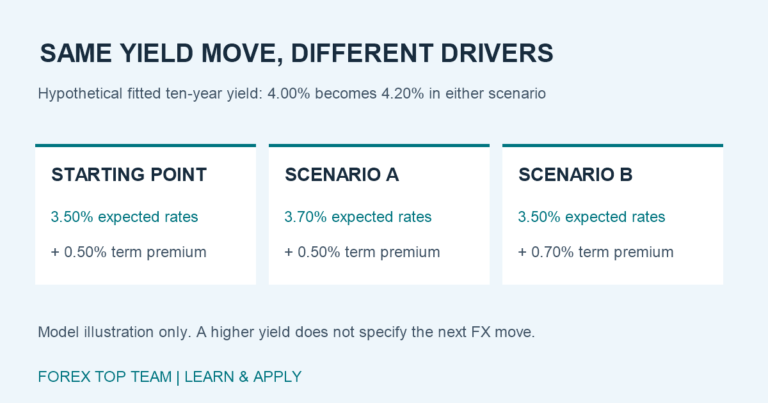
We should also consider why U.S. yields are rising. A rise driven by expectations of tighter monetary policy may affect the dollar differently from one caused by Treasury selling amid fiscal concerns.
In Japan, attention turns to remarks by BOJ Policy Board member Koeda on October 15 and a greeting by Governor Kazuo Ueda on October 16. Deputy Governor Ryozo Himino is scheduled to read Ueda's remarks on his behalf. Markets will look for any change in the Bank's stance on further rate increases.
Fiscal concerns for European currencies; jobs for the Australian dollar
The euro remains vulnerable to disputes over France's budget and concerns about government bonds. Even if buyers step in, a renewed widening of the French-German government bond yield spread would make a sustained recovery less certain.
The pound has support from expectations of another rate hike, but the UK's fiscal outlook is also a concern. We will want to distinguish a rise in UK yields driven by monetary-policy expectations from one reflecting worries about government debt. UK GDP and production data on October 15 will test the economy's resilience.
For the Australian dollar, the RBA minutes on October 13 and employment report on October 15 are in focus. Strong jobs data could keep expectations of another rate increase alive; weak data could fuel expectations that the hiking cycle is over.
The Canadian dollar faces concerns about economic momentum following the decline in employment reported on October 9. We will watch whether the currency's recovery continues, while also keeping oil prices and U.S.-Canada trade tensions in view.
The South African rand may also struggle to advance while U.S. yields remain high. In addition to domestic interest rates, global risk aversion will matter.
Key events next week
All dates and times are Japan Standard Time (JST).
| Date | Main events |
|---|---|
| Monday, October 12 | Japan closed for Sports Day; U.S. bond market closed |
| Tuesday, October 13 | Japan corporate goods price index; RBA minutes |
| Wednesday, October 14 | U.S. CPI; China trade balance and price data |
| Thursday, October 15 | Australian employment; UK GDP; U.S. retail sales, PPI, and initial jobless claims; remarks by BOJ Policy Board member Koeda |
| Friday, October 16 | BOJ Governor Ueda's greeting, read by Deputy Governor Himino; U.S. import and export prices; opportunity for remarks by the Fed Chair |
The schedule is subject to change.
Weekly P/L: −$7,131. Rebuild the case before the next trade
Trading from October 5 to 9 resulted in a weekly total of −$7,131.
Next week, rather than rushing to recover the loss, I will wait to see whether the moves in yields and currencies after U.S. CPI and retail sales persist before deciding on a trade. I will also follow Russian diesel supply through actual exports and fuel-price changes, not just the announcement.
In light of the BTC and NZD/USD trade results, any decision to buy again should be based on a fresh review of the rationale and acceptable loss, separate from the previous trade. Even if prices rebound in the short term, a rebound alone is not enough while daily or hourly charts continue to trend lower; I will watch how price behaves afterward.
Japanese and U.S. market holidays overlap at the start of the week, while major data releases cluster midweek. I will prioritize waiting for a clearer direction over increasing the number of trades, and manage the combined loss exposure across multiple positions.
Afterword: Sleep loss can be hard to judge by feel alone
When you are watching the markets, have you ever thought, “I was a little short on sleep yesterday, but I’ll be fine today”? After several nights of following price action late into the evening, it can feel as if you have adjusted to sleeping less. Let’s be careful not to use that feeling alone to judge how we are doing.
In a 2003 study published in the journal Sleep, Van Dongen and colleagues conducted sleep-restriction experiments involving 48 healthy adults. In one part of the study, participants were assigned to spend 4, 6, or 8 hours in bed each night for 14 days. Performance on tasks measuring attention and other functions declined over time in the 4-hour and 6-hour groups.
One notable finding was that participants' perceived sleepiness rose at first but did not continue rising as sharply. They could feel about as sleepy as the day before, even while their performance on the tasks had worsened. This was a laboratory study, not research into FX trading results. Still, it offers a useful reminder not to judge the effects of short sleep by subjective feelings alone.
How much sleep should we aim for? The U.S. Centers for Disease Control and Prevention (CDC) recommends at least 7 hours for adults aged 18–60, 7–9 hours for those aged 61–64, and 7–8 hours for adults 65 and older. But meeting a target number of hours is not the whole picture. Pay attention to sleep quality too, such as waking repeatedly during the night or not feeling rested in the morning.
For a few days, try making a simple note of when you go to bed, when you wake up, and how sleepy you feel during the day. As with a trading journal, a written record can make patterns easier to notice than relying on memory alone. Use it as a chance to review your routine: perhaps you feel tired the day after waiting for U.S. data, or you find yourself checking the market several times during the night.
Then try narrowing down what you check in the evening, or moving checks that can wait until morning to the next day, so that you can protect time for rest. You might step away from screens before bed or limit caffeine from the afternoon into the evening. Choose one manageable change at a time. If difficulty sleeping or strong daytime sleepiness persists, talk with a healthcare professional rather than simply putting up with it.
New market-moving information arrives every week. You do not have to follow every development around the clock; let’s find a routine that is sustainable. Next week, alongside managing capital, let’s also pay attention to managing sleep and rest.
Research: Van Dongen et al., “The cumulative cost of additional wakefulness: dose-response effects on neurobehavioral functions and sleep physiology from chronic sleep restriction and total sleep deprivation,” Sleep (2003).
Sources
- Bank of Japan, scheduled public speeches and remarks: Bank of Japan
- Van Dongen et al., Sleep 26(2), 117–126 (2003): DOI
- CDC, About Sleep: CDC
- U.S. Bureau of Labor Statistics, October 2026 release schedule: BLS
- Federal Reserve Bank of New York, October 2026 economic indicators calendar: New York Fed
- Associated Press, “Boosting US oil supplies with Russian diesel unlikely to have much impact on prices, experts say” (Oct. 10, 2026): AP