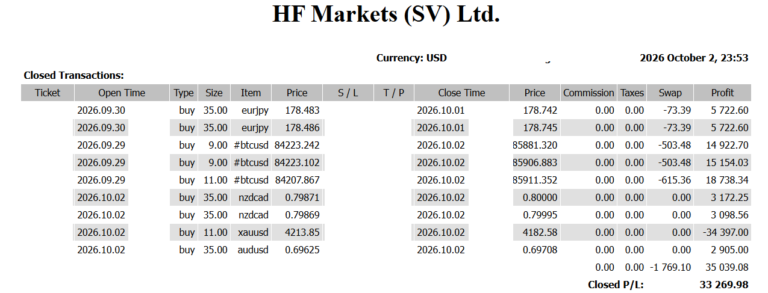
+108,894 USD | Will the Impact of Coordinated U.S.–Japan Intervention Last?
Focus Shifts from Buying USD/JPY to Selling EUR/JPY Rallies
Trading Results | July 27–31, 2026
Weekly Total: +108,894 USD
■ Weekly Review
This week was marked by severe turbulence in the foreign exchange market amid speculation that Japanese and U.S. authorities had jointly intervened to support the yen.
USD/JPY climbed to just below 164 earlier in the week before plunging into the 157 area.
The pair moved by more than six yen within only a few days, producing a major correction in what had previously been a largely one-way yen-selling market.
Despite the extreme volatility, we were able to secure a weekly profit of +108,894 USD.
However, the size of both weekly gains and losses has recently increased.
This reflects not only higher market volatility, but also the growing influence of intervention speculation and unexpected headlines relative to conventional economic indicators and monetary-policy developments.
Going forward, the priority will be risk control rather than aggressively pursuing additional profits.
● Reduce position sizes
● Avoid unnecessary entries
● Wait for price action to stabilize
● Focus only on the highest-conviction opportunities
■ Strategy Going Forward
The latest intervention episode has materially changed the assumptions that had supported the previous yen-selling trend.
The U.S.–Japan interest-rate differential remains wide, and the structural forces behind yen weakness have not disappeared.
However, if the United States was involved in efforts to correct excessive yen weakness, chasing USD/JPY at elevated levels has clearly become more dangerous.
The strategy going forward will be:
● Avoid chasing sharp rebounds in USD/JPY
● Prioritize selling rallies in yen crosses
● Closely monitor EUR/JPY for selling opportunities
● Reduce position sizes when intervention speculation intensifies
● Remain alert to abrupt moves caused by thin summer liquidity
FX Strategy Update
August 3–7, 2026 | Market Outlook
Previous Week’s Performance: +108,894 USD
■ Next Week’s Main Market Theme
The central question for next week is:
“Was the yen’s surge following coordinated U.S.–Japan intervention only temporary, or does it mark the beginning of a new market regime?”
The scale of the latest yen rally appears difficult to explain through Japanese intervention alone.
Reports suggest that the Federal Reserve Bank of New York, acting on behalf of the U.S. Treasury, may have sold euros and purchased yen through major financial institutions.
This has not been officially confirmed.
However, if accurate, it would mean that the United States directly participated in efforts to correct excessive yen weakness.
In previous intervention episodes, yen selling generally resumed after the initial shock because of the persistent interest-rate differential between Japan and the United States.
That strategy may become less effective if U.S. authorities are now also concerned about the weakness of the yen.
A large number of economic releases are scheduled next week, including the U.S. employment report.
However, the following questions may be even more important than the data:
● Will the U.S. Treasury continue purchasing yen?
● Will Japanese authorities conduct another intervention?
● Which currency will be sold to fund future yen purchases?
● Will the United States and Japan coordinate again if the yen weakens rapidly?
■ USD/JPY Strategy
USD/JPY may attempt to rebound following the intervention-driven collapse, but the upside is likely to be heavier than before.
The interest-rate differential between the United States and Japan and continued demand for yen-funded carry trades mean that importers and short-term traders may buy the pair after sharp declines.
However, another rapid rise in USD/JPY would immediately revive intervention concerns.
If the latest operation was coordinated between the United States and Japan, market participants will remain alert to the possibility of additional intervention during every significant rebound.
USD/JPY could therefore become trapped between dip-buying demand and intervention risk, producing highly volatile but directionless price action.
Rather than chasing gains, the preferred approach is to assess the strength of each rebound and the response from policymakers before entering short-term positions.
■ U.S. Employment Report and USD/JPY
The U.S. employment report will be next week’s most important scheduled economic release.
Current market forecasts are:
● Nonfarm payrolls: +88,000
● Unemployment rate: 4.2%
● Average hourly earnings: +3.5% year-on-year
A stronger-than-expected report could push U.S. yields and the dollar higher.
However, if USD/JPY rises too quickly, intervention concerns will intensify at the same time.
Traders should therefore be prepared for a scenario in which the pair initially rallies after the release but then reverses sharply.
A weaker report could combine lower U.S. rate expectations, dollar selling, and intervention concerns, accelerating declines in USD/JPY.
For this employment report, the potential downside move may be larger than the potential upside move.
■ EUR/JPY Strategy
EUR/JPY is the pair I will be watching most closely for selling opportunities next week.
If reports that U.S. authorities purchased yen by selling euros are accurate, EUR/JPY could become a direct target during any future intervention operation.
Several bearish factors are currently aligned against EUR/JPY:
● Potential euro selling and yen buying by U.S. authorities
● Yen-buying intervention by Japan
● Unwinding of yen-funded carry trades
● The European Central Bank’s cautious policy stance
● Concerns over the European economic outlook
● Higher energy costs caused by instability in the Middle East
USD/JPY is still likely to attract dip-buying demand because of the U.S.–Japan interest-rate differential.
EUR/JPY, however, also faces weakness on the euro side.
If intervention speculation intensifies again, EUR/JPY could therefore fall more sharply than USD/JPY.
The pair has already declined substantially, so the preferred strategy is not to chase the market lower.
Instead, I will look for selling opportunities after a meaningful corrective rebound.
■ EUR/USD Strategy
EUR/USD will be driven largely by the direction of the dollar following the U.S. employment report.
A weak report could push the pair higher through renewed dollar selling.
However, the euro continues to face several negative factors, including slower European growth, a cautious ECB, and higher energy costs caused by Middle East tensions.
Reports that the United States sold euros during its intervention operation may also weigh on broader euro sentiment.
Rather than buying the euro solely because the dollar is weakening, I will consider selling rallies if upward momentum fails to continue.
■ GBP/JPY Strategy
Sterling continues to receive some support after the number of Bank of England policymakers favoring a rate increase increased at the latest meeting.
However, concerns over higher government spending and the fiscal burden under the new administration are limiting the upside.
Sterling may remain relatively resilient against the dollar, but GBP/JPY is likely to be driven primarily by intervention developments and broader yen flows.
If renewed yen buying emerges, GBP/JPY could decline sharply.
I will avoid buying at elevated levels and will assess the pair cautiously while monitoring USD/JPY and EUR/JPY.
■ CAD/JPY Strategy
The Canadian employment report will be the main domestic catalyst for the Canadian dollar.
Stronger labor-market data could support the currency.
However, in CAD/JPY, intervention flows and the broader direction of the yen are likely to matter more than Canadian economic data.
Even if the employment report is strong, renewed yen buying could limit any advance in CAD/JPY.
Crude oil prices and U.S. trade policy will also require close attention.
■ AUD/JPY Strategy
Expectations for another Reserve Bank of Australia rate increase have weakened following softer inflation data.
As a result, the Australian dollar may struggle to extend gains.
AUD/JPY is also highly sensitive to yen-funded carry trades and can fall sharply when those positions are unwound during intervention episodes.
If USD/JPY declines again, AUD/JPY could be dragged lower.
I will avoid aggressive long positions and wait for a clear sign that selling pressure has stabilized.
■ ZAR/JPY Strategy
High interest rates continue to provide some support for the South African rand, while weaker domestic growth remains a headwind.
ZAR/JPY is a widely used carry-trade pair and may experience a sharp decline if yen-buying intervention resumes and leveraged positions are unwound.
Rather than buying at elevated levels solely because of the interest-rate differential, traders should first confirm that the yen market has stabilized.
■ Core Strategy for the Week
Next week, intervention-related headlines may reverse market direction without warning, regardless of conventional economic data.
The core strategy is therefore:
● Do not chase rebounds in USD/JPY
● Prioritize monitoring EUR/JPY for selling opportunities
● Reduce exposure before and after the U.S. employment report
● Avoid yen-selling positions when intervention speculation intensifies
● Prepare for abrupt moves caused by thin summer liquidity
● Avoid holding the same directional yen risk across multiple currency pairs
● Prioritize capital protection over profit maximization
In the current environment, a single incorrect decision can result in a significant loss.
The objective is not to increase the number of trades, but to wait for situations in which intervention flows and the broader market direction are aligned.
■ Final Scenario
Next week is likely to be defined by a conflict between:
“USD/JPY buying supported by the U.S.–Japan interest-rate differential”
and
“Yen buying driven by fears of coordinated U.S.–Japan intervention.”
A strong U.S. employment report could trigger a rebound in USD/JPY, but a rapid rise would also increase the risk of additional intervention.
A weak report could combine lower U.S. yields, dollar selling, and intervention concerns, accelerating declines in both USD/JPY and the yen crosses.
EUR/JPY remains the main pair to watch.
If markets begin to price in another round of euro selling and yen buying by U.S. authorities, EUR/JPY could decline more sharply than USD/JPY.
The main strategy for next week is:
“Do not chase USD/JPY higher. Look for opportunities to sell EUR/JPY rallies.”
With profit and loss swings becoming larger, this is not the time to expand risk unnecessarily.
The priority is to concentrate only on the market situations offering the clearest advantage.
■ Closing Thoughts: The Best Investment May Be Tonight’s Sleep
“Maybe I should study a little more.”
“Perhaps I should watch the charts for another hour.”
Many traders have sacrificed sleep while thinking this way.
Effort is important.
However, sleep is increasingly viewed not merely as time spent resting, but as time that improves performance.
Research suggests that inadequate sleep may affect concentration, decision-making, mood, cardiovascular function, immunity, and the risk of conditions such as obesity and diabetes.
Several basic habits may improve sleep quality:
● Get natural sunlight during the day
● Reduce exposure to smartphones and other blue-light devices during the two hours before bedtime
● Avoid caffeine later in the day
● Maintain consistent sleeping and waking times
None of these habits is especially complicated.
That is precisely why they can be maintained over time.
The same principle applies to trading.
Consistently successful traders rely less on extraordinary talent and more on disciplined daily routines.
Risk management.
A trading journal.
Market analysis.
And proper rest.
Maintaining stable judgment every day is far more valuable than forcing yourself to work excessively for a single session.
Wealth is not created overnight.
However, protecting sleep improves the quality of the following day’s decisions.
Over time, those better decisions can create a significant difference in investment results.
Next week, let us continue investing not only in the time spent analyzing charts, but also in the sleep required to trade calmly and consistently.