
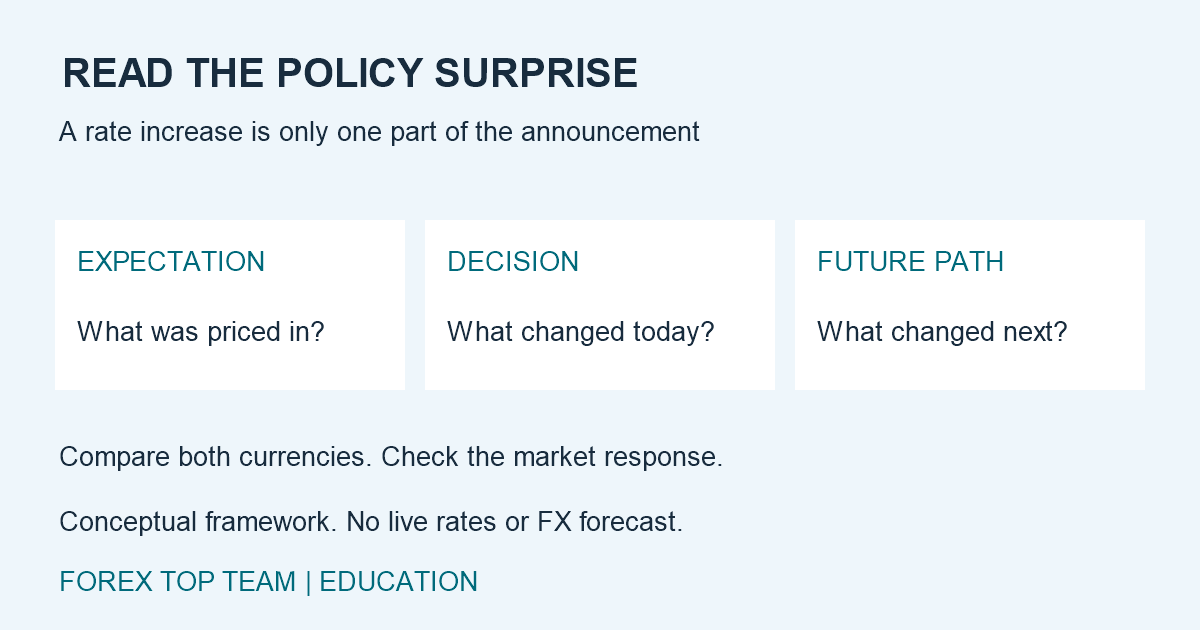
A central bank raises interest rates, and its currency falls. If you have ever watched that happen, you know how confusing the first few minutes can feel. Was the headline wrong, or did the market simply ignore it?
The useful question is what changed compared with what traders expected. A rate decision is one part of the announcement. The statement, forecasts and press conference may change the outlook for several future meetings.
This article offers a practical framework for reading that information. All numerical examples are hypothetical. There are no claims about current policy rates, market pricing or today’s currency moves.
Separate the decision from the surprise
Suppose a central bank raises its policy rate by 25 basis points. One basis point is 0.01 percentage point, so this is an increase of 0.25 percentage point. Whether the decision surprises traders depends on the expectation recorded before publication.
If investors broadly expected that increase, the decision may add little new information. If they expected 50 basis points, a 25-basis-point increase could be interpreted as less restrictive than anticipated, even though the rate still rose.
These are possible interpretations, not trading rules. Do not infer what was expected simply because the currency moved. Record a dated, identifiable expectation source before the announcement, and distinguish a survey of economists from prices in interest-rate markets.
Read the path beyond this meeting
Imagine that traders expected a hypothetical increase today followed by two further increases. The central bank delivers today’s increase but signals that it may pause while assessing incoming data. The current rate is higher; the expected future path may nevertheless shift lower.
The ECB’s explanation of monetary-policy transmission describes how expectations about future short-term rates affect medium- and long-term rates, and how policy can affect exchange rates. That mechanism helps explain why the headline decision alone is incomplete.
Listen for changes in conditions. Does further tightening depend on inflation remaining persistent? Is the committee giving more attention to employment or financial stress? A conditional statement is different from a commitment to a specific action.
The New York Fed’s policy implementation overview discusses forward guidance: communication about the economic outlook and likely policy course that can shape expectations. Treat guidance as information to evaluate alongside subsequent data.
Remember that a currency pair has two sides
For EUR/USD, you are comparing the euro with the US dollar. A change in the European outlook is only part of the story. The expected US policy path may change at the same time, or broader events may affect both markets.
Suppose comparable two-year government yields are hypothetically 4.00% in the United States and 3.00% in Germany before an announcement. The US-minus-German spread is 1.00 percentage point, or 100 basis points.
Afterward, suppose the US yield is 3.90% and the German yield is 3.10%. The spread becomes 0.80 percentage point, or 80 basis points: a narrowing of 20 basis points. This arithmetic describes a relative change; it does not imply a particular EUR/USD price target.
Government yields are imperfect policy proxies. They also reflect risk premia and other influences. Compare the same maturity at consistent timestamps, and avoid mixing a delayed quote on one side with a live quote on the other.
Build a simple announcement worksheet
Before the release, write down the scheduled publication time and timezone, your expectation source, the previous statement’s relevant wording, and the scenario that would challenge your interpretation. Keep the worksheet short enough to use under pressure.
After the release, separate three observations: the actual decision, changes in the wording, and the market response. Link to the central bank’s original release rather than relying entirely on a short headline.
If you track rates and FX, define your observation windows in advance. For example, use the last available quote before publication, then observations five and thirty minutes afterward. These intervals are organizational choices, not evidence that waiting a particular number of minutes creates an edge.
Record whether the press conference began inside your window. A move after an answer to a journalist may reflect new information that was absent from the initial statement.
When the signals disagree, slow down
Suppose the currency declines while the relative yield movement appears supportive. Write down the disagreement before inventing a story. Risk sentiment, liquidity, another simultaneous release or the limitations of your rate proxy may be relevant.
Positioning is another possible explanation, but it should remain a hypothesis unless supported by appropriately timed data. A sharp reversal does not prove that traders were overcrowded or that a large institution deliberately trapped the market.
The ECB notes that monetary transmission has variable and uncertain lags. Its framework explains channels; it does not promise a mechanical exchange-rate response to each policy decision. Your worksheet should preserve uncertainty rather than turn every move into a confident explanation.
Keep the interpretation separate from your risk limit
A well-supported policy view can still produce a losing trade. Fast markets may widen spreads or create slippage, and a stop order may execute worse than planned. Your interpretation does not remove those execution risks.
Choose in advance whether your strategy permits entering during announcements. If it does, specify the maximum planned cash risk, exit logic and conditions for staying out. Our position-sizing guide connects the stop distance with exposure and costs.
For your next practice review, compare an announcement with the expectation recorded beforehand. Summarize the difference in one sentence, check the relative rate movement, and note what remains unexplained. That habit can improve the quality of your analysis without pretending to forecast every currency reaction.