[-US$41,713] Dollar Strength After the FOMC, Yen Weakness After the BOJ
Thin Holiday Trading and Intervention Risk Are the Next Focus
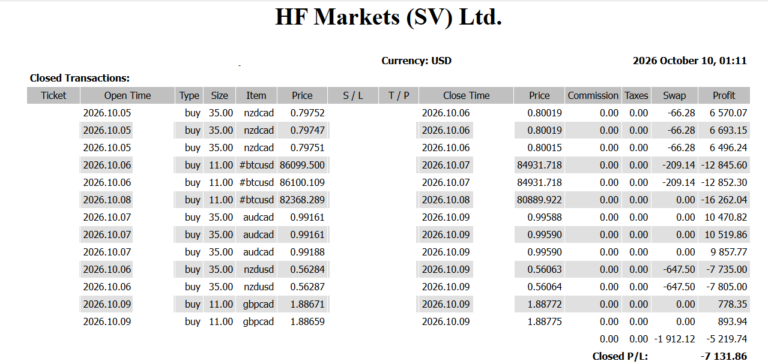
Trading Results
14–18 September
Weekly Total: -US$41,713
Weekly Review
This week, trends that had been working through the previous week were substantially reversed, making directional judgement particularly difficult.
BTC fell early in the week before rebounding from the US$80,000 range.
Crude oil reversed sharply higher after declining the previous week, only to fall again later.
USD/CAD moved modestly higher, maintaining a broadly dollar-positive bias.
Crude oil was particularly challenging.
What initially appeared to be a continuation of the previous week’s downtrend became a sharp rebound, followed by another decline. Direction changed repeatedly within a short period.
As a result, the weekly performance was -US$41,713.
The key lesson from this market is that:
“A winning pattern from the previous week will not necessarily continue into the following week.”
In particular, the area for improvement in crude oil trading is to avoid being anchored to the prior week’s successful short positions and shift more quickly to the new trend developing during the current week.
FX Strategy Update
Market Outlook
21–25 September 2026
Previous Week’s Performance: -US$41,713
Key Theme for Next Week
The main theme for next week is:
“Will the post-FOMC dollar rally continue, or will it enter a correction from elevated levels?”
The FOMC delivered a 0.25% rate hike and indicated one further increase before year-end.
The outcome was more hawkish than markets had expected, lifting longer-term US yields and strengthening dollar buying.
The BOJ also raised rates by 0.25%, but yen selling rather than yen buying became dominant because:
• Two members voted to keep rates unchanged.
• The timing of the next rate hike was not indicated.
• Consecutive rate hikes were not clearly signalled.
The current combination supporting USD/JPY is therefore:
“The Federal Reserve is more hawkish than expected, while the BOJ is less hawkish than expected.”
However, intervention concerns are intensifying around 158, creating substantial upside risk as well.
USD/JPY Strategy
The basic structure in USD/JPY is a tug-of-war between:
Dollar buying driven by rising US yields
and
Upside resistance created by intervention concerns.
If Fed officials continue to support further rate hikes, the dollar-positive trend is likely to remain intact.
However, substantial dollar buying has already occurred after the FOMC. If Fed comments are less hawkish than market expectations, profit-taking could emerge.
Particular attention is needed around 158 due to the risk of:
• Rate checks
• Ministry of Finance warnings against excessive yen weakness
• Speculation about actual market intervention
For this reason, rather than chasing USD/JPY higher simply because the dollar is strong, priority should be given to monitoring both US yields and the response from Japanese authorities.
Caution During Thin Holiday Trading
Japanese markets will enter an extended holiday period early next week, leaving fewer domestic participants in the market.
In these conditions, relatively small orders can create larger-than-usual price moves.
Key risks include:
• Speculative yen selling
• Sudden intervention speculation triggering yen buying
• Middle East-related headlines
• Sharp moves in US yields
If USD/JPY rises rapidly during thin trading conditions, intervention concerns are likely to intensify more quickly than usual.
Position sizes should be kept small early next week, with priority given to risk management that can withstand abrupt market moves.
Crude Oil Strategy
Crude oil will remain an important trading market next week.
If Middle East tensions worsen, the following chain may strengthen again:
Supply concerns
↓
Higher oil prices
↓
Renewed concern over US inflation
↓
Expectations of further Fed rate hikes
↓
Dollar buying
Conversely, diplomatic progress or hopes for a ceasefire could trigger a sharp pullback in oil.
As seen last week, an established trend can reverse in a short period.
The priority next week is not to be influenced by the previous week’s successes or losses, but to:
“Confirm the day’s direction in crude oil before entering.”
EUR/USD Strategy
The focus for EUR/USD will be European PMIs.
Weak German or eurozone PMIs could lead to:
• Concern over a European economic slowdown
• Reduced expectations of further ECB rate hikes
• Euro selling
Conversely, stronger-than-expected figures could prompt a short-term euro rebound.
However, expectations of further Fed rate hikes are currently supporting the dollar, which is likely to keep upside in EUR/USD limited.
The basic approach is to monitor selling on rallies while assuming continued dollar strength.
GBP Strategy
The Bank of England kept rates unchanged, but three members voted for a hike.
If inflation remains elevated, expectations of further tightening could strengthen again.
However, weakness remains in the UK economy.
Next week, UK PMIs and comments from BOE officials will be important:
• If inflation concerns dominate, sterling buying may emerge.
• If economic slowdown concerns dominate, sterling selling may strengthen.
CAD Strategy
The Canadian dollar is supported by expectations of an earlier BOC rate hike.
However, the following factors are likely to limit upside:
• US-Canada trade tensions
• Broad dollar strength
• Changes in the direction of oil prices
USD/CAD can offer relatively clear directional opportunities. It should be closely monitored when broad dollar strength and the direction of oil prices point in the same direction.
AUD Strategy
Australian employment data will be the main focus for the Australian dollar.
A strong result could increase expectations of further RBA rate hikes and support AUD buying.
Conversely, weak employment data could reduce tightening expectations and lead to AUD selling.
Rather than committing to a direction before the event, the reaction in yields after the release should be confirmed.
BTC Strategy
BTC rebounded sharply from the US$80,000 range last week.
However, entering at the initial stage of a sharp rebound can leave traders vulnerable to a short-term reversal.
The preferred approach remains:
Initial move
↓
Confirmation of direction
↓
Correction
↓
Re-entry
In particular, renewed rises in US yields could limit upside in BTC.
Core Strategy for the Week
The priority next week is:
“Not predicting the direction perfectly, but responding quickly to change.”
The core approach is:
• Monitor post-FOMC dollar strength as the base scenario.
• Prioritise intervention risk around USD/JPY 158.
• Keep position sizes small during the extended holiday period.
• Do not become fixed on the previous week’s direction in crude oil.
• Do not chase BTC at the initial move.
• Prioritise markets with clear direction, such as USD/CAD.
• Adjust quickly if the trend changes after key events.
Final Scenario
The base scenario for next week is:
Continued dollar strength after the FOMC.
If Fed officials support further rate hikes and long-term US yields continue to rise, dollar buying may remain intact.
However, intervention concerns will intensify rapidly in USD/JPY around 158.
Conversely, if Middle East tensions ease, oil declines and Fed officials adopt a more cautious stance on further rate hikes, post-FOMC dollar buying may unwind.
The core policy for next week is:
“Do not assume that the previous week’s trend will continue; reassess the current week’s market from zero.”
As the crude oil market demonstrated this week, a winning pattern from the previous week will not necessarily continue.
The focus will be on confirming new trends in the dollar, crude oil and BTC, then concentrating on the market offering the strongest edge.
Afterword: Stepping Away From the Market Can Be a Strategy on Days You Have Not Slept Well
Trading requires all kinds of preparation:
chart analysis, economic data, interest rates and news.
However, one factor that is often overlooked is your own condition.
Lack of sleep is not simply about feeling tired.
It can increase sensitivity to pain and make headaches or migraines more likely. For many adults, around seven to nine hours of sleep per night is often considered a useful benchmark.
When you watch the market while sleep-deprived, it becomes easier to lose concentration, react more slowly, enter trades you would normally avoid, or overreact to a small unrealised loss.
The risk in trading is that you may feel you are making decisions as usual, while the quality of those decisions has actually declined.
Even when the market environment itself is not problematic, poor physical condition can create losses that did not need to be taken.
That is why sleep should be considered part of trading preparation, just like capital management.
Going to bed at roughly the same time each day, reducing caffeine before bed, keeping the room dark and quiet, and avoiding screens immediately before sleeping can all help support better sleep quality.
There is also an important option in trading:
“Do not force a trade today.”
On days when you feel unwell, have not slept enough, or cannot concentrate, staying out of the market is also sound risk management.
You do not need to win every day.
What matters is making consistently good decisions when you are in a good condition to make them.
Next week as well, I will continue to monitor not only the market environment but also my own condition, and aim to trade calmly without forcing opportunities.