【+83,544 USD】USD/JPY Returns to 160: U.S. Employment Report Is Next in Focus|Are Rate-Hike Expectations Real?
Trading Results, 24–28 August
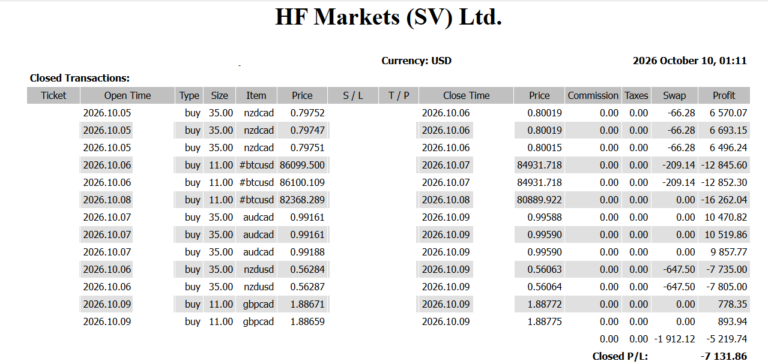
Weekly Total: +83,544 USD
This Week’s Summary
This week, the Jackson Hole Symposium shifted the market from the dollar weakness seen in the previous week back toward dollar buying.
USD/JPY traded around 159 early in the week. However, Fed Chair Warsh’s speech on 28 August revived expectations of further U.S. rate hikes.
USD/JPY recovered the 160 level, while EUR/USD fell into the upper 1.15 range.
The market theme shifted from:
“Dollar selling driven by falling U.S. yields”
to:
“Dollar buying driven by inflation concerns and rate-hike expectations.”
Weekly performance was +83,544 USD.
By concentrating on markets where direction became clear, we were able to build profits throughout the week.
Market Characteristics
The market structure was:
・Dollar: recovered on the Fed’s hawkish stance
・USD/JPY: returned above 160
・EUR/USD: declined on dollar strength
・AUD: remained firm due to persistent inflation
・CAD: weighed down by U.S.-Canada trade issues
Most importantly, USD/JPY returned above 160 even after massive yen-buying intervention.
The latest intervention reportedly totaled around ¥15 trillion. Even so, yen-selling pressure driven by the Japan-U.S. yield differential has not completely faded.
However, “intervention having limited effect” and “there will be no further intervention” are entirely different things.
At levels above 160, the risk of a sharp decline remains significant.
Outlook and Strategy
Next week, the base case is continued dollar buying, while U.S. employment data will determine whether that trend can truly continue.
The core approach is:
・Prioritize dollar buying while U.S. yields continue to rise
・Avoid chasing USD/JPY at highs above 160
・Reduce position size ahead of the U.S. employment report
・Assess not only the data itself, but also the reaction in U.S. yields
・Monitor currencies with their own catalysts, including AUD and NZD
・Avoid forcing entries in markets where direction has weakened
FX Strategy Update
Market Outlook for 31 August–4 September 2026
Previous Week’s Performance: +83,544 USD
Next Week’s Market Theme
The biggest theme next week is:
“Will economic data validate the U.S. rate-hike expectations that increased after Jackson Hole?”
Following Chair Warsh’s speech, market pricing for a September FOMC rate hike rose sharply.
However, further sustained dollar strength will require support from economic data.
Key releases next week include:
・ISM Manufacturing
・JOLTS Job Openings
・ADP Employment Report
・ISM Services
・U.S. Employment Report
The U.S. employment report on 4 September will be the week’s main event.
U.S. Employment Report
The previous employment report showed not only a decline in payrolls, but also significant downward revisions to prior figures.
Therefore, the key question this time is not simply whether employment returns to positive territory.
Focus should be on:
・The scale of payroll recovery
・Revisions to prior data
・The unemployment rate
・Labor-force participation
・Average hourly earnings
If employment recovers more than expected and wages remain strong, the following trend could continue:
Higher U.S. rate-hike expectations
↓
Higher U.S. yields
↓
Dollar buying
Conversely, if employment data weakens again or prior figures are revised lower, dollar-buying positions accumulated after Jackson Hole could be unwound.
USD/JPY Strategy
USD/JPY has returned above 160.
The current rise is supported by:
・U.S. rate-hike expectations
・The Japan-U.S. interest-rate differential
・Persistent yen selling
・Concerns over Japan’s fiscal position
Strong U.S. data could push the pair toward 161.
However, intervention concerns become extremely strong above 160.
Unlike in earlier phases of the market, the strategy of automatically chasing USD/JPY higher after strong U.S. data is dangerous.
A sharp rally immediately after strong data is exactly when traders should be alert to official comments or yen-buying intervention.
The basic approach is to avoid chasing highs and instead assess pullbacks or post-intervention price action before making decisions.
U.S. Yields Remain the Most Important Signal
Next week, the focus should be less on the economic data itself and more on:
“How did U.S. yields react?”
Even if data is strong, dollar buying may not last if U.S. yields do not rise.
Conversely, even if data is somewhat weak, the dollar may remain supported if U.S. yields stay elevated.
The sequence to monitor is:
Economic data
↓
U.S. yields
↓
Dollar
EUR/USD Strategy
EUR/USD is expected to favor selling on rebounds as long as dollar strength continues.
Strong euro-area CPI could create a short-term euro-buying move, but Fed rate expectations currently have a greater market impact.
If U.S. yields remain high, look for selling opportunities above the 1.16 area.
If the U.S. employment report is weak and the market shifts toward dollar selling, reset the strategy.
AUD/USD Strategy
AUD is relatively attractive.
Australian CPI remains elevated, keeping expectations for further RBA rate hikes alive.
If Australian GDP is also strong, the combination of a hawkish RBA and resilient Australian growth could support AUD.
However, a strong rise in U.S. yields may still cap AUD/USD.
The key is to compare AUD-specific strength against broad dollar strength.
NZD/USD Strategy
For NZD, the policy rate is the main focus.
If a rate hike is already fully priced in, the more important question becomes:
“Will there be another rate hike?”
If the RBNZ maintains an additional-tightening bias, it could support NZD downside.
Conversely, if markets conclude that the current hike marks the end of the cycle, NZD may be sold on a “buy the rumor, sell the fact” reaction.
CAD Strategy
For CAD, the Bank of Canada policy rate and employment data are key.
However, trade tensions with the United States are currently a larger risk than monetary policy.
Even if higher oil prices or strong economic data support CAD, worsening trade friction could limit sustained buying.
The approach is to avoid forcing positions until a clearer direction emerges.
GOLD Strategy
Gold will also remain in focus.
At present, the following dynamic is a headwind for gold:
Higher U.S. rate-hike expectations
↓
Higher U.S. yields
↓
Stronger dollar
However, if Middle East tensions or concerns over financial markets intensify again, gold may be bought as a safe-haven asset.
Therefore, next week’s approach shifts away from simple dip buying toward:
“Buy only after confirming a reversal in U.S. yields.”
Core Strategy for the Week
Next week becomes increasingly important toward its second half.
The main strategy is:
・Use continued dollar strength as the base case early in the week
・Use ISM, JOLTS, and ADP to assess the employment trend
・Maintain dollar buying if U.S. yields continue to rise
・Prioritize intervention risk above 160 in USD/JPY
・Reduce position size before the employment report
・After the report, focus on the U.S. yield reaction rather than the headline number alone
・Abandon the dollar-buying strategy if U.S. yields reverse lower
Final Scenario
Next week’s market depends on:
“Can U.S. employment justify the dollar strength that followed Jackson Hole?”
If employment is strong:
Higher U.S. rate-hike expectations
↓
Higher U.S. yields
↓
Continued dollar strength
In this scenario, maintain dollar-buying strategies in dollar pairs such as EUR/USD.
If employment is weak:
Fading rate-hike expectations
↓
Lower U.S. yields
↓
Unwinding of dollar buying
This could bring the market back toward the dollar-weakness trend seen in the previous week.
For USD/JPY, intervention risk above 160 cannot be ignored under either scenario.
Therefore, the core strategy for next week is:
“Use dollar strength as the base case, but do not chase USD/JPY above 160.”
Focus on U.S. employment data, U.S. yields, and intervention risk. Concentrate only on markets with the clearest direction.
Afterword: People Who Live Long and Traders Who Win Long-Term Both Rely on Fundamentals
When people hear “a special way to live longer,” they may imagine expensive supplements or the latest health trend.
Yet the habits associated with longevity are surprisingly simple:
・Eat plenty of vegetables, fruit, legumes, and whole grains
・Stay physically active
・Avoid smoking
・Do not let stress build up excessively
・Value human connections
・Maintain consistent, restful sleep
The accumulation of these basic habits is closely linked to healthy longevity.
What is particularly interesting is that there is no single method that guarantees a long life.
It is not sleep alone.
It is not exercise alone.
It is not diet alone.
What matters is maintaining several good habits consistently and sustainably.
Exactly the same is true in trading.
Many people search for a secret indicator or a strategy that never loses.
But traders who remain in the market over the long term value capital management, stop losses, market analysis, the judgment to stay out, emotional control, and the discipline to continue applying these principles for years.
More important than one big win is staying in the market for the long term.
More important than one perfect strategy is continuing to follow multiple fundamentals.
Health and investing may ultimately lead to the same conclusion.
There is no need to do anything flashy.
Improve small daily habits, little by little.
Over 10 or 20 years, that accumulation creates a major difference.
Next week as well, rather than chasing only immediate profit, let us focus first on long-term survival in the market and continue building trades based on solid fundamentals.