The chart touches your entry level, turns upward, and leaves your buy limit behind. It feels as though the platform missed an obvious trade. Before changing your strategy or blaming the broker, check which price touched the level and what your order actually requested.
A limit order controls the price you are willing to accept. It does not promise participation in every move. This guide explains how to review a missed FX entry, using hypothetical quotes and a simple order journal. No live prices or execution statistics are being reported.
A price condition is not a filled position
For a buy limit, you specify the highest acceptable purchase price. For a sell limit, you specify the lowest acceptable sale price. In ordinary retail FX quoting, the ask is the price at which you buy and the bid is the price at which you sell.
MetaTrader 5’s trading principles describe buy-limit conditions in terms of the ask and sell-limit conditions in terms of the bid. The same guide distinguishes an order, which is an instruction, from a deal, which is an actual execution.
That distinction is your starting point. A chart observation, an accepted pending order and a completed deal are three different pieces of evidence. Your account’s order history tells you which stage was reached.
Check the side of the quote
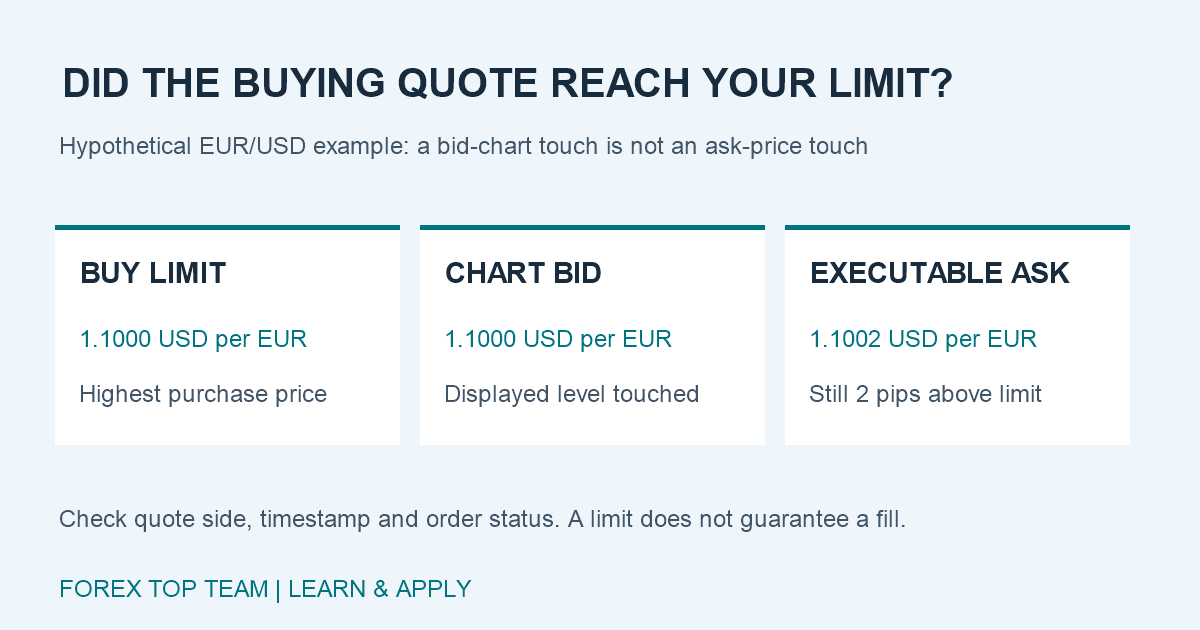
Suppose you have an accepted, hypothetical EUR/USD buy limit at 1.1000. EUR/USD is quoted in US dollars per euro, and one pip is 0.0001. Assume your chart displays bid prices and the account uses the ask-based buy-limit condition described above.
- The displayed bid falls to 1.1000.
- The ask is still 1.1002.
- The spread is 0.0002, or two pips.
The chart has touched 1.1000, but the available buying quote is two pips above your limit. Your stated price condition has not been met. This is a quote-side mismatch, not evidence that a qualifying trade was ignored.
Now imagine a later quote of 1.0998 bid and 1.1000 ask. The ask has reached the requested price. That resolves the first question, but you still need to check whether the order remained active and whether execution was available under the account’s rules.
For a sell limit, reverse the check: examine the bid. Also confirm whether the chart uses bid, midpoint or last-traded prices. Exchange instruments can follow different triggering rules, so do not transfer a spot-FX example to every symbol on the platform.
Compare the evidence at the same moment
A screenshot taken after the move may show a normal spread even if the spread was wider during the apparent touch. Record both quotes at the relevant timestamp, including the server timezone. A candle’s low compresses many observations into one number and may not tell you the simultaneous ask.
Then review the order ticket: symbol, side, volume, requested price, placement time and expiration. Was the order accepted before that quote arrived? Had it expired or been canceled? Did an account or instrument restriction prevent the requested operation?
A missing fill needs a specific explanation supported by records. If the evidence is incomplete, label the cause unknown. Do not turn a remembered chart pattern into a confident accusation or a claim that the same entry would have succeeded elsewhere.
The cost of waiting is not just the spread
A hypothetical market purchase at 1.1002 would cost $2 more than a purchase at 1.1000 for EUR 10,000: 0.0002 dollars per euro multiplied by 10,000 euros. That comparison assumes both prices were executable for the same size and excludes commissions.
The limit order may save that price difference if filled. It may also leave you without a position. Choosing between those outcomes is part of the strategy, not a technical detail to solve after a rally begins.
Write the rule beforehand. For example, your plan might require a pullback at an acceptable price and otherwise skip the trade. A different plan might prioritize participation after confirmation. Neither approach earns an automatic advantage simply from its order label.
A lower purchase price can also arrive because the market is deteriorating. If the trade’s original reasoning has become invalid, being filled cheaply is not necessarily good news. Review the signal as well as the entry price.
A stop-limit adds another condition
A stop-limit order first waits for an activation level and then places a limit order. MetaQuotes’ order-type explanation distinguishes that sequence from an ordinary stop operation. A fast move can activate the instruction without subsequently trading at an acceptable limit price.
Do not substitute a stop-limit for a protective exit just because it limits the execution price. Consider what happens if the position remains open. Our weekend-gap guide explains why trigger levels and actual execution outcomes must be reviewed separately.
Build a journal that includes missed trades
Record every qualifying signal, including orders that never filled. Track whether a signal occurred, whether an order was accepted, whether it filled, and what happened afterward under a predefined observation window.
Looking only at completed trades can hide how often the strategy misses its intended opportunities. Looking only at missed winners creates the opposite distortion. Include missed losers too, and keep any hypothetical outcome clearly separate from realized account profit.
Before your next order, confirm quote side, order validity, size, expiry and the action you will take if no fill occurs. The practical goal is a repeatable entry rule with evidence you can audit. Next, extend the journal to compare actual execution costs across similar market conditions.