EUR/USD is rising, but EUR/JPY barely moves. Is the euro signal failing, or are you asking one chart to explain a different pair?
A cross rate connects two currencies through a third. For EUR/JPY, the relationship between EUR/USD and USD/JPY helps you separate euro strength against the dollar from yen strength against the dollar. That makes a cross-rate check useful when several charts seem to disagree.
This article uses hypothetical prices and simplified calculations. It contains no current quotes, trading signals or claims that a price difference can be traded profitably.
Let the units show you the formula
In EUR/USD, the euro is the base currency and the dollar is the quote currency: the number expresses dollars per euro. USD/JPY expresses yen per dollar. CME Group’s quote-conventions lesson explains the base and quote distinction and warns that futures conventions can differ from spot conventions.
Multiplying dollars per euro by yen per dollar cancels the dollar unit. What remains is yen per euro, the EUR/JPY quote:
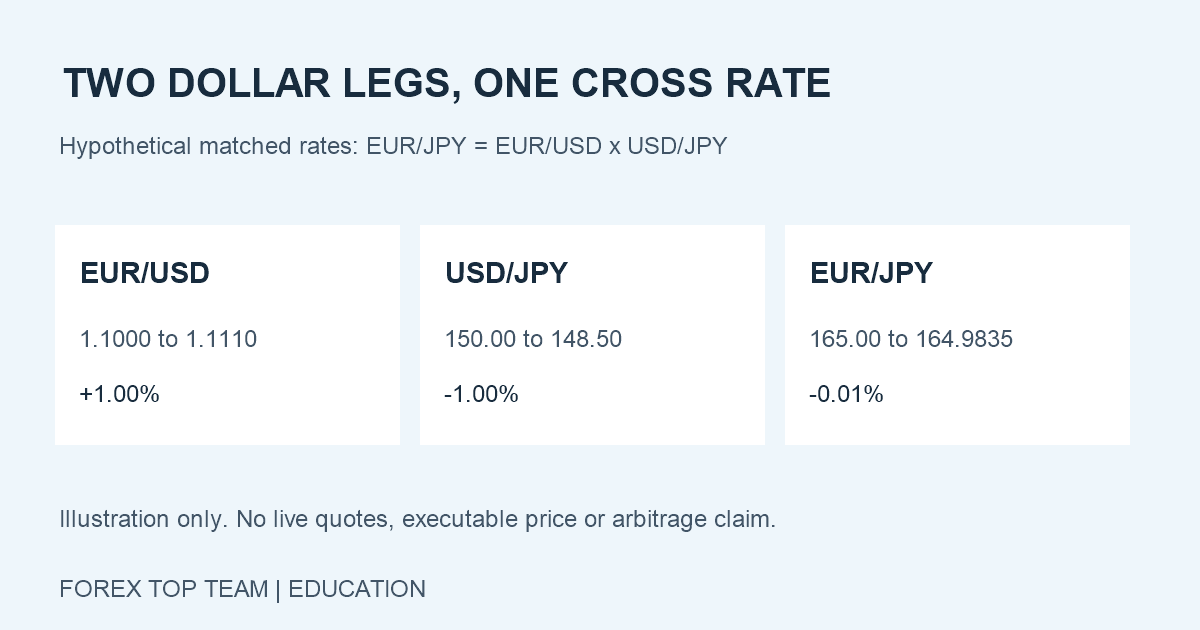
EUR/JPY = EUR/USD x USD/JPY.
At hypothetical values of 1.1000 dollars per euro and 150.00 yen per dollar, the calculated cross is 165.00 yen per euro. This is a consistency calculation using matched illustrative rates, not a broker’s executable offer.
Two moves can almost cancel
Now let EUR/USD rise 1% to 1.1110 while USD/JPY falls 1% to 148.50. The calculated EUR/JPY rate becomes 1.1110 x 148.50 = 164.9835.
Relative to 165.00, that is a decline of 0.01%. The euro gained against the dollar, but the yen also gained against the dollar. The cross compares the euro directly with the yen, so the two changes nearly offset in this example.
The exact proportional relationship is (1 + cross return) = (1 + EUR/USD return) x (1 + USD/JPY return), when the rates refer to the same start and end observations. Here, 1.01 x 0.99 = 0.9999.
Simply adding +1% and -1% would suggest zero, missing the small interaction term. For modest moves that shortcut may be close, but use the exact ratio when checking your worksheet. It also prevents confusion between percentage changes and pip changes.
Do not add pips across different pairs
A conventional pip is 0.0001 for EUR/USD and 0.01 for EUR/JPY. Those are different units with different cash values. An equal count of pips does not mean the two pairs moved by the same percentage or exposed an account to the same loss.
For a hypothetical EUR/JPY position of 10,000 euros, a move of 0.01 yen per euro corresponds to JPY 100 before costs. In a USD account, that yen amount must be converted into dollars using an appropriate rate. State the position units, account currency and conversion assumption rather than borrowing a familiar EUR/USD pip value.
Cross-rate arithmetic can help explain prices, but it does not replace position sizing or the execution rules of the instrument you actually trade.
Bid and ask prices matter
A midpoint is halfway between a bid and an ask. It can be useful for describing movement, but it is not the price available on both sides of a trade.
In an idealized two-leg conversion with matching timestamps and sufficient available size, selling euros for yen through dollars uses the EUR/USD bid followed by the USD/JPY bid. Buying euros with yen uses the corresponding asks. The resulting synthetic cross therefore has a bid and an ask, not just one multiplied midpoint.
Real orders introduce additional conditions: fees, available liquidity, changing quotes and the possibility that one leg fills before the other. A screenshot showing different prices is not enough to establish an arbitrage opportunity. It may show stale data, incompatible products or a difference smaller than the costs of execution.
Keep reference rates separate from tradeable quotes
The ECB’s euro reference-rate page states that its rates are published for information purposes and discourages their use for transactions. That makes them useful for certain consistent historical comparisons, but they should not be presented as prices a trader can execute.
Before comparing a direct cross with a calculated cross, record whether each input is spot, a reference fixing, a broker derivative or a futures contract. Futures also have contract maturities; a spot quote and a dated futures quote are not interchangeable observations.
For actual data, preserve the timestamp and timezone of every input. Mixing a fresh USD/JPY quote with an earlier EUR/USD value can create an apparent mismatch that comes from your worksheet rather than the market.
Use the relationship to ask better questions
When EUR/JPY rises, inspect both dollar legs over the same interval. Did EUR/USD rise while USD/JPY stayed stable? Did USD/JPY rise while EUR/USD changed little? Or did both contribute?
This describes the price decomposition. It does not prove the economic cause. Policy announcements, yield changes and other events need their own dated evidence; the algebra cannot establish which headline motivated traders.
Our dollar-index and USD/JPY guide explains a related distinction between a basket and a bilateral pair. A broad dollar headline is not a substitute for examining the currencies in the specific cross.
For your next practice review, build a three-column worksheet with synchronized EUR/USD, USD/JPY and EUR/JPY observations. Label quote types, check the units and calculate proportional changes. Then write a separate explanation of what remains uncertain. Next, extend the exercise to account-currency pip values and shared currency exposure across your positions.