The dollar index is rising, but USD/JPY is falling. Your charts seem to disagree, and a headline about broad dollar strength does not explain the trade you are watching.
That combination is possible without either chart being wrong. An index summarizes a basket; USD/JPY compares only two currencies. Understanding that difference can prevent you from treating a broad headline as a ready-made signal for a specific pair.
This article uses hypothetical prices and an original calculation. It does not report today’s index level, currency quotes or market positioning.
Know which dollar index you are reading
The commonly watched ICE US Dollar Index, often called DXY, combines six currencies. ICE lists the component weights as 57.6% for the euro, 13.6% for the Japanese yen, 11.9% for sterling, 9.1% for the Canadian dollar, 4.2% for the Swedish krona and 3.6% for the Swiss franc.
These weights are not equal. A move involving the euro can have a substantial effect on the index even when the yen moves differently. The weights describe the calculation, not the probability that each currency will follow the index.
The index uses a geometric calculation. In plain language, it combines weighted proportional changes rather than simply adding the six exchange-rate prices. Some constituent quotes must be inverted so that the result consistently measures dollar strength.
Check the quote direction before comparing charts
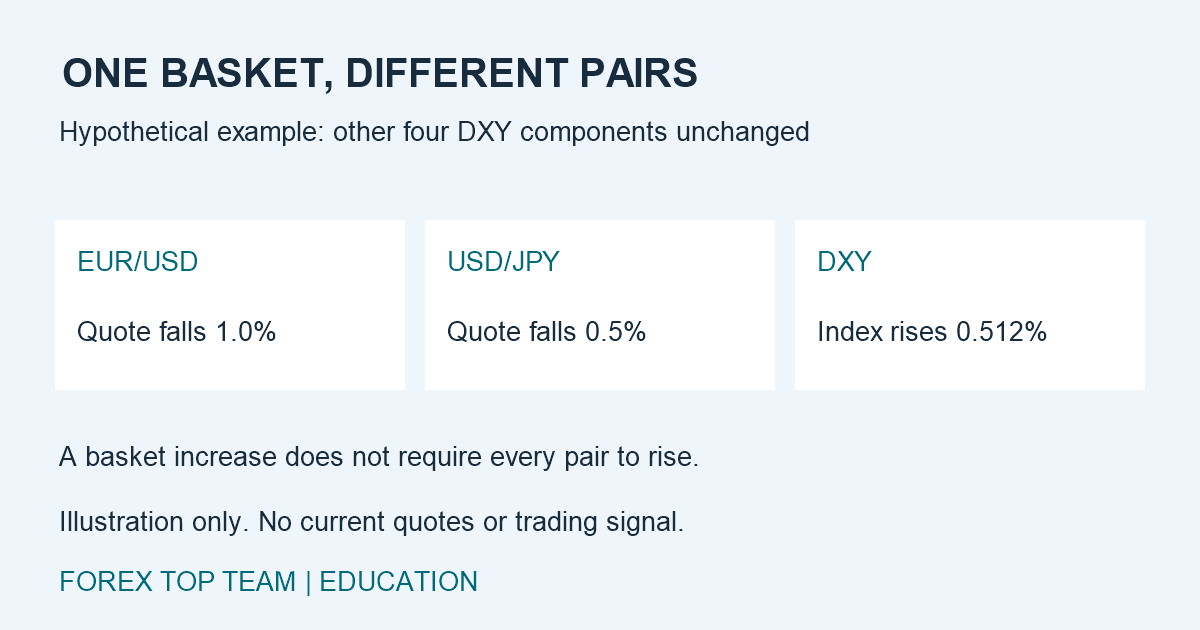
EUR/USD expresses US dollars per euro. A fall from a hypothetical 1.1000 to 1.0890 is a 1% decline in that quote and means the euro buys fewer dollars.
USD/JPY expresses Japanese yen per US dollar. A fall from a hypothetical 150.00 to 149.25 is a 0.5% decline and means the dollar buys fewer yen. The first movement shows dollar strength against the euro; the second shows dollar weakness against the yen.
Do not compare the direction of the two chart lines without acknowledging the different quote conventions. Also remember that reciprocal percentage changes are not exactly equal and opposite: a 1% fall in EUR/USD corresponds to about a 1.0101% rise in its reciprocal.
A small calculation shows how the apparent conflict works
Keep the other four DXY currency components unchanged for this illustration. Using the euro and yen weights, the index ratio after those two moves is:
DXY ratio = (1.0890 / 1.1000)-0.576 x (149.25 / 150.00)0.136.
The result is approximately 1.00512, equivalent to an index increase of about 0.512%. The constant used to set the index level cancels when calculating the ratio.
So the index rises while USD/JPY falls. The euro-related contribution outweighs the yen-related contribution under these assumptions. This is a mathematical example of basket behavior, not a forecast or a reconstruction of an actual trading session.
If several components changed at once, you would need to include all of them. A glance at one euro chart is not enough to establish the precise driver of an observed index move.
Use the basket as context, then examine the pair
When the index and your pair diverge, start with a descriptive question: which currencies are moving, and over what interval? The answer may reveal a concentrated euro move rather than a uniform change across the dollar’s counterparts.
Next, examine the information relevant to both currencies in the pair. For USD/JPY, that could include changes in the US and Japanese policy outlook, relative yields or a verified country-specific announcement. Those are candidate explanations to investigate, not reasons to attribute every divergence to one familiar narrative.
Our guide to policy surprises explains why the expected path of policy and the comparison between two economies matter. An index reading cannot replace that bilateral analysis.
Different indices answer different questions
DXY is not interchangeable with every measure labeled a dollar index. The BIS effective-exchange-rate overview describes nominal indices built from geometric trade-weighted averages, with weights that adjust over time. Its real indices also account for relative consumer prices.
A broad trade-weighted measure can help with questions about international competitiveness. A nominal bilateral quote is more directly connected to the price of the pair you can trade. A real effective index is not an intraday signal and should not be read as if it were an executable FX quote.
Record the index provider and series definition before comparing results. Two indices may move differently because their baskets, weights, observation frequencies or price adjustments differ.
Build a comparison you can actually trust
Use the same start and end timestamps, including the timezone. Comparing a daily index return with a five-minute USD/JPY move can create an apparent disagreement that is simply a mismatch of horizons.
Check whether the index display is a cash index, a futures contract or a broker’s derivative quote. Delayed data and different session cutoffs can also distort the comparison. If you cannot reconcile the observations, label the interpretation uncertain rather than filling the gap with a confident story.
Finally, keep risk decisions tied to the actual instrument. A rising dollar basket does not guarantee that a long USD/JPY position will gain, and a historical correlation does not impose a fixed relationship on the next trade.
For a practice review, collect synchronized returns for your pair, DXY and its largest components. Describe whether dollar strength was broad or concentrated, then write down the evidence relevant to the pair itself. That habit makes a headline more useful without asking it to answer a question its basket was not designed to settle.