You have a stop-loss in place, so holding a forex trade over the weekend feels manageable. But what if the next available price is already beyond that stop? The useful question is not just where your stop sits. It is how much a different execution price would cost your account.
This guide explains weekend gap risk and shows how to stress-test a position before you leave it unattended. All prices and account figures below are hypothetical. They are not current quotes, a forecast for the next opening or a recommendation to hold any particular trade.
What a gap changes about your stop
A gap is a jump between available prices rather than a continuous path through every intermediate level. News can arrive while your broker is not accepting trades. When quoting resumes, the price available for closing a position may differ from the last price you saw.
OANDA Corporation’s operating-hours guidance says positions cannot be opened or closed when its markets are closed. It also explains that reopening gaps can trigger orders at a prevailing rate different from the requested stop level. This is one broker’s explanation; check the documents for your own account and instrument.
A conventional stop-loss is therefore an instruction with execution conditions, not a universal guarantee of a fixed loss. Slippage means the difference between your intended execution price and the actual fill. A weekend gap is one situation where that difference can become important.
Put the risk into account-currency units
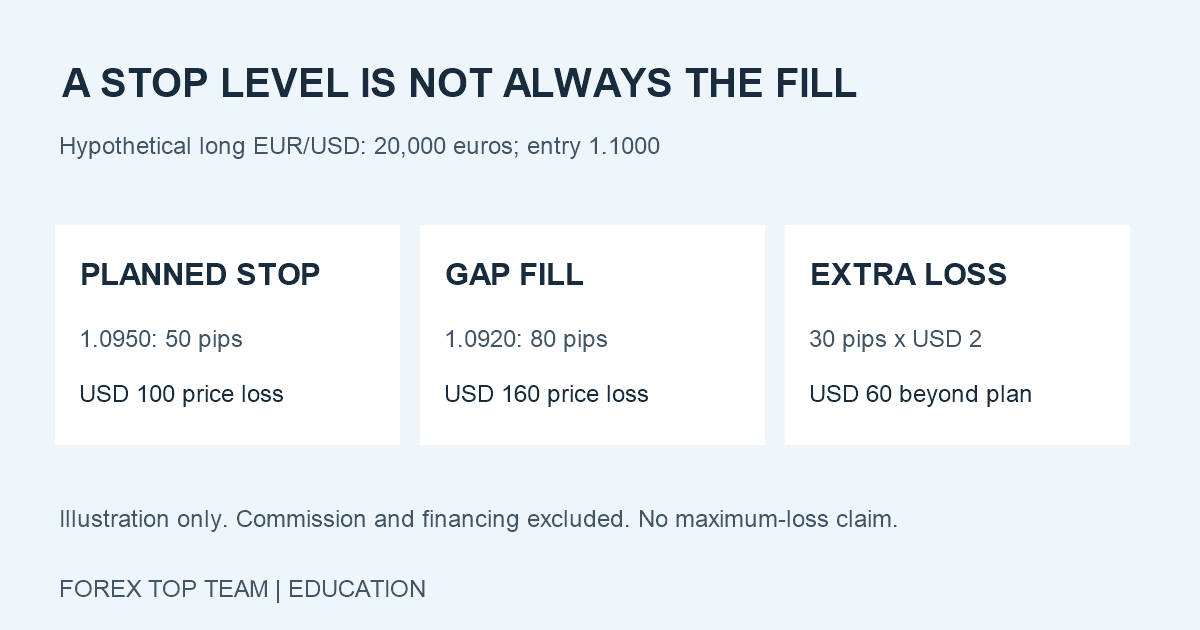
Imagine a hypothetical USD-denominated account holding a long EUR/USD position of 20,000 euros. The actual entry fill is 1.1000 US dollars per euro, and the stop is 1.0950. One pip in this example is 0.0001 dollar per euro.
The planned price distance is 50 pips. Each pip is worth 20,000 x 0.0001 = USD 2, so execution exactly at the stop would produce a USD 100 price loss. On hypothetical equity of USD 10,000, that is 1%.
Now suppose the first executable closing bid is 1.0920 and the position closes there. The total entry-to-exit distance is 80 pips, so the price loss is USD 160, or 1.6% of starting equity. The fill is 30 pips worse than the stop, adding USD 60 to the planned price loss.
The example uses the actual entry fill and closing bid, so do not add a separate spread charge to the same price difference. Commission and financing, if applicable, still need their own treatment. For pairs whose quote currency differs from your account currency, convert the loss using an appropriate conversion rate and test that rate too.
Use scenarios without pretending they are probabilities
Start with the planned stop fill, then test several worse execution distances. In the same hypothetical trade, an additional 10, 30 or 75 pips beyond the stop would imply price losses of USD 120, USD 160 or USD 250 respectively.
These are sensitivity tests: they show how the position reacts to chosen assumptions. They do not say how likely any gap is, and the largest scenario is not a maximum possible loss. Historical observations can inform the choices, but a quiet sample does not rule out an event you have never seen.
Our ATR guide explains why a recent movement estimate should not become a promised boundary. Apply the same caution when using average daily ranges to choose a weekend stress.
Keep spread risk and gap risk separate
A wider spread is a larger difference between the buying and selling quotes. It can affect a position even if the midpoint barely moves. A gap concerns a discontinuity in available prices. Both can occur around a reopening, but they are different mechanisms.
OANDA Canada’s spreads and margin page discusses spread increases when liquidity changes and the possibility of stop triggers or margin closeouts around these conditions. Account protections and execution rules depend on the contracting entity; do not transfer a protection described for one jurisdiction to another account.
Read which quote triggers your order, how execution follows that trigger and how your platform displays prices. A midpoint chart alone may not show the bid or ask that mattered. Check those rules before interpreting a stop fill as an unexplained platform error.
Review the whole account, not one ticket
Three positions can respond to the same currency shock. A long EUR/USD and long GBP/USD position both include short-dollar exposure, even though the charts look different. Adding separate planned stop losses can miss a common reopening scenario.
Create a simple inventory of direction, units, account-currency loss under each stress and the currencies shared across positions. Then consider the combined equity impact. Correlation can change during stress, so a historical diversification estimate is not a promise that one trade will offset another.
Margin is the collateral required to maintain exposure. It is not your loss budget. Verify the broker’s closeout calculation as well as the effect of adverse prices on equity; meeting an entry margin requirement does not establish that a weekend position is appropriately sized.
Make the next decision before trading closes
Before a future weekend, check instrument hours, timezone and holiday exceptions. Review known events from primary calendars, but leave room for unscheduled developments. Record your position inventory, assumed fills and the account impact you would accept.
If a chosen stress is too large for your plan, consider reducing or closing exposure while trading is available. Widening a stop at unchanged size increases the intended price loss; it does not remove gap risk. Adding funds changes collateral, not the underlying trade’s adverse price exposure.
After reopening, compare actual fills with your assumptions and keep the evidence. The practical lesson is to treat a stop as part of an execution plan, then size the exposure for uncertainty around that plan. Your next review can extend the same method to news releases and other interruptions in normal liquidity.