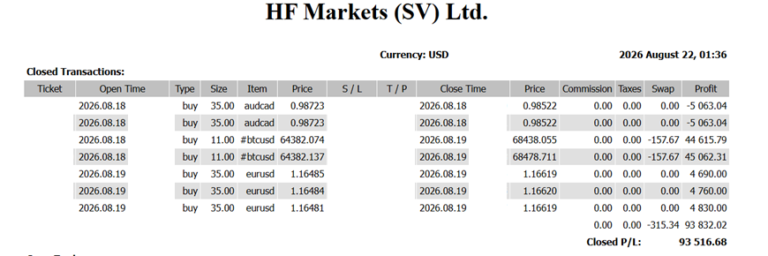
📊 +39,843 USD
What Should Traders Watch During a Geopolitical Market?
✅ Trading Results (March 9–13)
📊 Weekly Total: +39,843 USD
📉 Weekly Market Review
This week’s market structure was actually quite clear once you understood the core driver.
The energy market was unquestionably the main actor.
As tensions in the Middle East intensified, crude oil formed a strong uptrend, and that trend became the central axis of global markets.
As a result, the following structure emerged clearly:
-
Oil: strong upward trend
-
Commodity currencies: moved higher alongside energy
-
USD/JPY: rose on safe-haven dollar demand
-
Equities and crypto: lacked clear direction
The trades that worked best this week were:
-
Capturing the oil trend
-
Buying AUD supported by expectations of an RBA rate hike
On the other hand, short USD/JPY trades moved against the main market flow, becoming the primary source of losses.
In short, this week was a market where:
Energy and commodity currencies led the trend, and fighting the USD/JPY rally was not the right strategy.
🌍 Market Environment (March 9–13)
The dominant force in markets this week was not monetary policy — it was geopolitics.
Rising tensions involving the United States, Israel, and Iran caused markets to consistently price the following chain reaction:
Geopolitical risk → Higher oil prices → Stronger dollar
The rise in oil prices was not just a commodity move.
It triggered broader macro concerns:
-
Renewed inflation fears
-
Higher U.S. yields
-
Safe-haven demand for the dollar
This ultimately influenced the direction of the entire FX market.
Although ceasefire speculation appeared later in the week, Iran denied such developments and additional attacks were reported.
As a result, the geopolitical dollar bid remained intact.
■ Currency Review
1. USD/JPY
USD/JPY remained extremely resilient throughout the week.
At the start of the week, oil’s sharp rise triggered strong buying.
Later, oil temporarily declined, but USD/JPY pullbacks remained shallow, eventually rising into the upper 159 range.
The rally was supported by three key factors:
-
Safe-haven dollar demand
-
Inflation concerns driven by higher oil prices
-
Reduced expectations of a Bank of Japan rate hike
Importantly, this was not merely yen weakness.
It was more accurate to say the dollar itself was strong.
Even near 159, where intervention concerns began to emerge, buying pressure remained strong.
2. EUR/USD
EUR/USD struggled throughout the week.
Although the pair rose briefly early in the week, renewed dollar buying pushed it lower, eventually falling toward the low 1.14 area.
Europe’s heavy reliance on energy imports means Middle East tensions are particularly negative for the euro.
The euro was weighed down by:
-
Safe-haven dollar demand
-
European growth concerns
-
Rising energy costs
This created a market where sell-the-rally strategies worked well.
3. GBP
The pound showed mixed performance.
Against the dollar it was weak, but against the yen it held relatively firm.
Dollar strength capped GBP/USD, while USD/JPY’s rise helped support GBP/JPY.
However, the UK still faces several domestic risks:
-
Economic slowdown concerns
-
Uncertainty surrounding BOE policy
-
Political instability
As a result, upside momentum remained limited.
4. Canadian Dollar
The Canadian dollar showed a very clear dual structure this week.
Against the dollar:
-
Weak due to safe-haven USD demand
Against the yen:
-
Supported by oil prices and USD/JPY strength
In other words:
Weak vs USD, strong vs JPY.
As long as oil prices remain elevated, commodity currency support should continue.
However, strong global dollar demand limits CAD upside against the USD.
5. Australian Dollar
The Australian dollar was one of the stronger currencies this week.
Against the yen it rose strongly, supported by:
-
USD/JPY strength
-
Expectations of an RBA rate hike
Against the dollar, however, gains were more limited.
The AUD once again demonstrated its dual nature:
-
Strength as a commodity currency
-
Volatility as a risk-sensitive currency
That said, RBA policy expectations provided a clear tailwind this week, making AUD one of the more tradable currencies.
6. South African Rand
The South African rand was weak, unlike other commodity currencies.
Risk aversion and dollar strength led to selling pressure against both USD and JPY.
Although gold prices rose — normally supportive — this was outweighed by:
-
Geopolitical risk
-
Emerging-market currency selling
-
Strong global demand for USD
■ Key Themes for the Week of March 16
There are four major themes to watch next week:
-
Middle East tensions
-
Oil price volatility
-
Major central bank meetings
-
The battle around USD/JPY 160
1. Middle East Situation
This remains the foundation of the current market.
If tensions escalate further, we could again see:
Higher oil → stronger dollar → weaker equities
Markets are no longer in a normal environment.
Instead, we are now in a phase where one headline can move prices dramatically.
2. Oil Prices
Shipping disruptions around the Strait of Hormuz remain a major concern.
Even if the IEA releases strategic reserves, this would only provide temporary relief.
The structural supply risk remains.
In the current market structure:
Oil moves → FX moves
This relationship is extremely clear.
3. Major Central Bank Meetings
Next week features several major central bank events.
The most important will be the FOMC meeting.
Rates are expected to remain unchanged, but the focus will be on:
-
The dot plot
-
Chair Powell’s comments
Until recently, markets expected two rate cuts in 2026.
However, rising oil prices and inflation concerns are shifting expectations toward:
-
One rate cut
-
or no cuts at all
If rate-cut expectations decline further, the dollar could strengthen again.
4. USD/JPY and the 160 Level
USD/JPY has already reached the upper 159 range.
The key question next week is whether 160 will be broken.
However, intervention concerns will intensify above that level.
Even if the broader uptrend continues, price action could become extremely volatile.
■ Strategy Outlook (Week of March 16)
Next week may not be a clean trending market.
Instead, it is likely to become a headline-driven market with sharp swings.
Basic strategy framework:
-
USD/JPY: buy dips, but watch intervention risk above 160
-
EUR/USD / GBP/USD: sell rallies
-
CAD/JPY / AUD/JPY: upside potential depending on oil and central banks
-
ZAR/JPY: high volatility — trade cautiously
■ Final Thoughts
If we summarize the current market environment in one sentence:
Middle East tensions define the foundation of the market, while U.S. inflation data and central bank events determine the strength of the dollar.
The current currency structure can be summarized as:
-
USD: strong due to geopolitics and interest rates
-
JPY: weakened by policy expectations despite safe-haven status
-
EUR: pressured by energy risks
-
GBP: limited upside due to domestic uncertainty
-
CAD: supported by oil
-
AUD: supported by commodities and RBA expectations
-
ZAR: vulnerable to geopolitical risk
In other words, the key drivers next week will be:
-
Oil
-
FOMC
-
USD/JPY near 160
-
Middle East headlines
With markets capable of reversing sharply on a single news headline, asset selection will be more important than ever.
📜 Afterword | The Traders Who Last Long Are Those Who Design Their Environment
Thank you again for reading this week’s FX report.
Research and personal stories from people living with chronic migraines reveal an interesting common theme:
Success depends less on willpower and more on environmental design.
Strong lights, noise, smells, temperature changes, and stress can quickly reduce concentration and performance.
That is why many people manage their symptoms by carefully adjusting their working environment.
Interestingly, trading works in a very similar way.
📊 Don’t Fight the Market — Design Your Environment
When traders experience repeated losses, they often think:
“I need stronger discipline.”
But in reality, the problem is often environmental:
-
Watching charts too much
-
Consuming too much news
-
Trading with excessive position sizes
-
Lack of sleep
Successful traders spend a lot of time designing environments where they can think clearly.
🧠 Performance Is Determined by Environment
Watching charts in a quiet place.
Trading only during specific hours.
Focusing on only the most relevant information.
These simple adjustments dramatically improve decision-making quality.
It’s not about special skills — it’s about protecting your mental energy.
🌱 Be Kind to Yourself, Strict With Your Rules
One lesson learned by people managing chronic conditions is:
Don’t blame yourself.
The same applies to trading.
You don’t need to trade every market.
You don’t need to trade every day.
What matters most is maintaining your condition and staying in the game long enough.
Markets will always be there.
So take your time.
Stay calm.
Prepare your environment.
And patiently wait for the next opportunity.
See you next week.