You open the order window and see that a trade needs only a small amount of margin. Does that mean the trade carries only a small amount of risk? That is an easy conclusion to draw, especially when the platform still shows plenty of free margin.
But the amount reserved to open a position and the amount you could lose answer different questions. Separating them helps you avoid sizing trades around what the platform permits. This guide uses hypothetical figures, not live quotes or a recommended leverage level.
What margin actually tells you
Margin is collateral required to support a leveraged position. Leverage lets you control exposure larger than the funds committed as collateral. OANDA Corporation’s margin explanation describes this relationship and the potential for amplified losses. Its account rules apply to its own offering; your broker’s contracting entity and instrument specifications matter.
Think of margin as an admission requirement. Passing that requirement does not tell you whether an adverse price move would fit your trading plan. A lower requirement can make more exposure available without making the same existing position less sensitive to prices.
Keep three numbers on your worksheet
Start with notional exposure: the value of the position you control. Then record required margin: the collateral your broker calculates. Finally, estimate the cash loss under specified exit scenarios. Do not substitute one number for another.
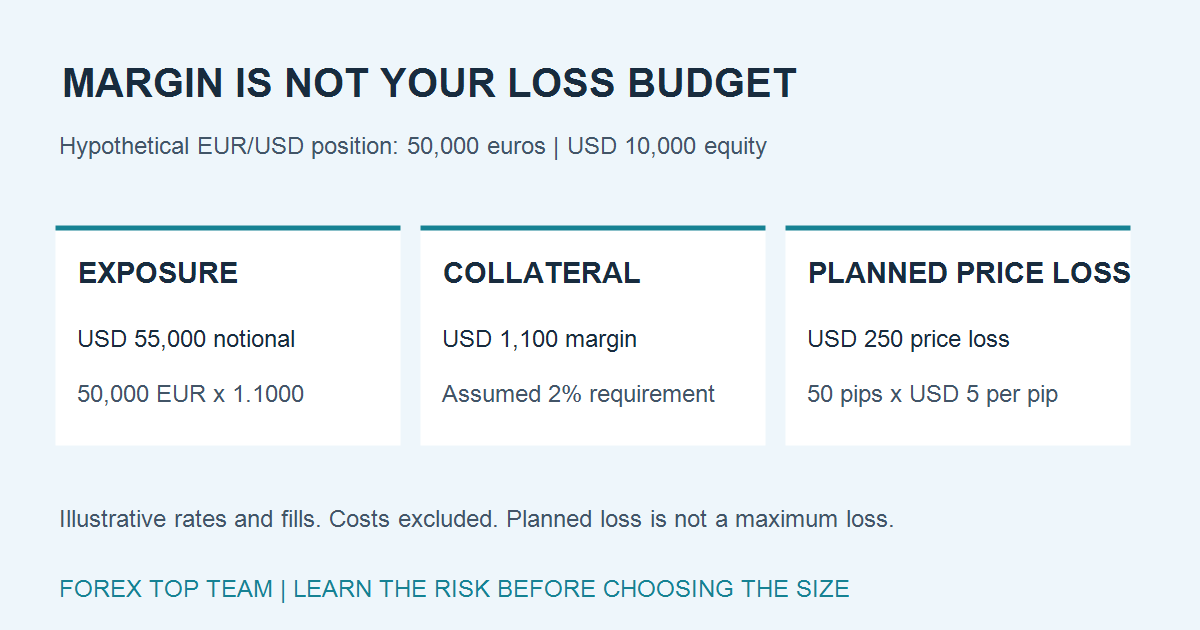
Imagine a hypothetical USD account with USD 10,000 in equity and a long EUR/USD position of 50,000 euros at 1.1000 dollars per euro. Its starting dollar notional is 50,000 x 1.1000 = USD 55,000.
For this simplified illustration, assume margin equals 2% of dollar notional. That gives USD 1,100. If the assumed requirement were instead 5%, margin would be USD 2,750. These are illustrative rates and a simplified calculation, not a statement of current account terms.
The position still contains 50,000 euros in either case. A one-pip move, defined here as 0.0001 dollar per euro, changes its price profit or loss by USD 5. Changing collateral alone has not changed that sensitivity.
Your effective leverage is a separate calculation
For this single-position example, effective leverage means dollar notional divided by account equity. USD 55,000 divided by USD 10,000 gives 5.5 times. This is different from the maximum leverage available under the broker’s margin rules.
If you select a smaller position, you use less effective leverage even when your account permits more. If equity falls while exposure stays broadly similar, this ratio can rise. That is one reason to review open positions against current equity rather than the deposit you remember making months ago.
Across multiple positions, total gross notional divided by equity is a useful exposure indicator, but it is not a complete risk model. It does not reveal which currencies offset, how correlations may change or what a shared event could do to several trades.
Translate the planned exit into money
Return to the hypothetical 50,000-euro position. An actual entry fill of 1.1000 and an assumed closing fill of 1.0950 imply a 50-pip decline. The price loss would be 50 x USD 5 = USD 250, or 2.5% of starting equity, before commission and financing.
That USD 250 is different from both USD 1,100 of assumed margin and USD 55,000 of notional. It is also conditional on the assumed closing fill. It is not the maximum possible loss.
If your hypothetical planning allowance were USD 100 at the same 50-pip distance, the corresponding size would be 100 / 0.0050 = 20,000 euros before additional costs. This calculation illustrates the process; it does not prescribe a suitable risk percentage.
Our weekend gap and stop-execution guide shows how a worse closing fill changes that calculation. When using actual entry and exit fills, avoid charging the same spread twice. Separately account for commission and financing where applicable.
Read free margin without mistaking it for safety
MetaTrader 5’s account-state documentation defines free margin as equity minus margin and margin level as equity divided by margin, multiplied by 100. It also describes broker-dependent conditions affecting the account calculation.
Under our simplified assumptions, USD 10,000 equity minus USD 1,100 margin leaves USD 8,900 free margin. The margin level is about 909.1%. Neither figure means you have chosen an acceptable loss budget. They describe collateral capacity at that moment.
Do not interpret a platform’s margin-level percentage as a probability of survival. Check your own warning and closeout rules, including whether they use a percentage or money threshold and how positions are liquidated. Requirements and account calculations can differ between instruments and entities.
Run the check before adding exposure
Before placing the next order, record units, quote direction, account-currency notional, margin requirement and cash loss for your planned exit. Then test a worse fill and a combined adverse move across positions sharing the same currency exposure.
Compare those losses with current equity and your written allowance. Check available collateral separately, leaving room for costs and changing conditions. For an EA, review how it behaves when equity shrinks or an additional order cannot be accepted; available margin should not be its only sizing input.
The practical habit is simple: choose exposure from a loss scenario you understand, then check whether the account can support it. Next, extend the worksheet to your whole portfolio so that several individually manageable trades do not quietly become one oversized currency bet.