Research edition: October 8, 2026
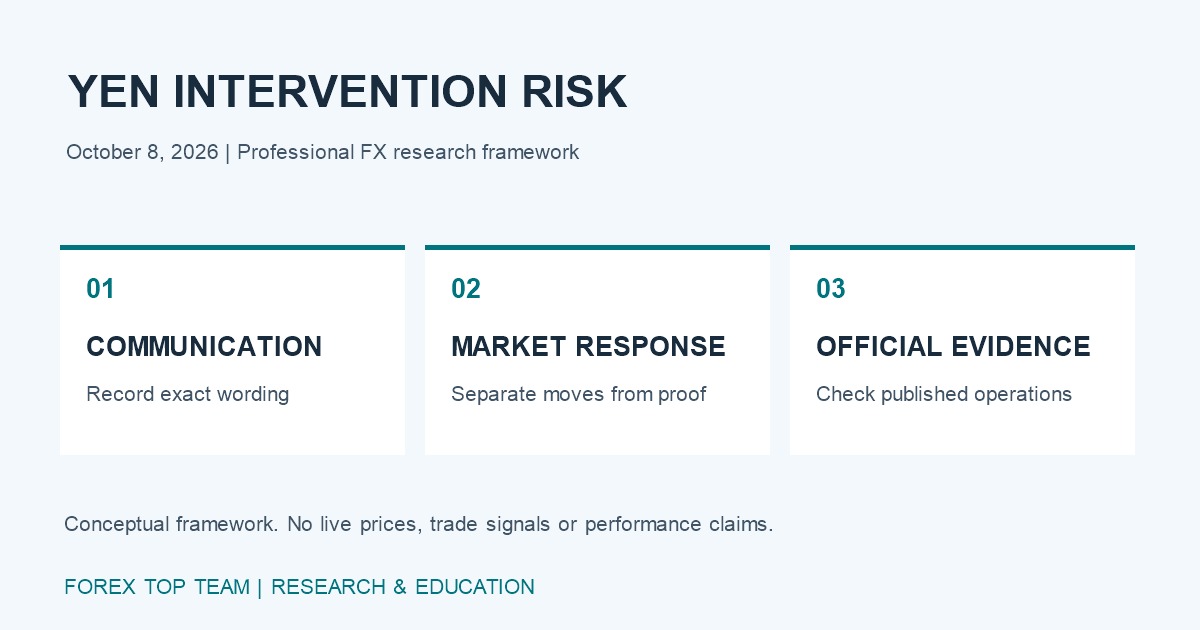
A sharp move in USD/JPY is evidence that prices changed, not proof that authorities intervened. Official warnings, unusual liquidity conditions and actual transactions belong to different categories of information. Combining them prematurely can turn a reasonable risk assessment into an unsupported claim. Professional analysis should identify what is observed, what is inferred and what remains unconfirmed.
This October 8, 2026 research edition sets out an evidence-based approach to intervention risk. It does not allege that an intervention occurred today, identify a current official exchange-rate threshold or provide a live trading signal. Illustrative scenarios are hypothetical.
Separate communication from a confirmed operation
Record the original statement, speaker, publication time and context. The wording of a warning can affect market expectations, but it is not the same as an executed FX operation. Distinguish a direct official statement from a press report, translation, market rumour or analyst paraphrase. Preserve uncertainty when the original wording cannot be checked.
Japan's Ministry of Finance publishes foreign-exchange intervention operations through official release pages. These provide an authoritative reference for disclosed activity. Publication has its own timing, so absence of a new release during an intraday move should not be interpreted as immediate proof either for or against intervention. Check the period covered by a release before associating it with a particular day.
Avoid inventing a precise trigger level
An exchange-rate level that attracted attention in a previous episode is not necessarily a standing intervention boundary. Policy assessments can depend on the speed, volatility and disorderliness of a move, together with the economic and international context. A convenient round number may concentrate orders and headlines even without any official commitment attached to it.
Construct a scenario around market conditions rather than asserting that authorities will act at a specific quote. For example, compare gradual depreciation in liquid trading with a rapid move accompanied by widening spreads and impaired depth. The comparison identifies different risk environments; it does not establish an official reaction function or a reliable trading rule.
Map the possible transmission channels
A yen-buying operation, if confirmed, directly changes supply and demand in the currency market. Its effect can also propagate through expectations, position reduction and execution constraints. Participants may respond before any official announcement because they change their assessment of the probability of action. That expectation effect must remain distinct from evidence of an actual transaction.
The persistence of an initial move depends on the surrounding market. Interest-rate differentials, global risk sentiment and investor positioning may reinforce or offset it. An immediate fall in USD/JPY therefore cannot establish that its longer-term direction has changed. Analyse the initial price impact and the subsequent persistence as separate observations.
Diagnose price action without overclaiming causation
Time-stamp the move and compare multiple observable variables: exchange-rate changes, spreads, trading conditions and relevant rate movements. A move occurring simultaneously with a data release or a major risk headline has plausible competing explanations. Explain those alternatives instead of treating speed alone as a definitive intervention signature.
Suppose a hypothetical pair falls 1.5% in several minutes, then recovers half the move. This reveals a large short-horizon adjustment and a partial reversal. It does not identify the initiating participant, the amount transacted or the net exposure of dealers. Those claims require additional evidence beyond a price chart.
Compare data sources carefully. Different venues can show different highs and lows during fast markets. Quote frequency, bid-versus-ask conventions and timestamps can create apparent discrepancies. Before reporting an exceptional move, confirm that the measurement is comparable across the sources and is not an isolated stale quote.
Translate uncertainty into portfolio constraints
Intervention uncertainty should be reflected in exposure limits and stress assumptions rather than in confidence about a precise event time. Evaluate gaps beyond stops, temporary spread widening and simultaneous losses across correlated yen positions. A long USD/JPY position and another position short yen can contribute to the same portfolio vulnerability even when the trading strategies differ.
In a hypothetical account with five times equity exposure, a 2% adverse underlying move produces an approximate 10% equity effect before costs and conversion details. This linear illustration shows why leverage matters. It is not a maximum-loss estimate: actual execution, margin rules and nonlinear portfolio effects can change the result materially.
Define escalation conditions before the event. These might include a sudden deterioration in execution quality, an official communication that changes the scenario assessment or a portfolio exposure limit being reached. The purpose is to create a controlled response to uncertainty, not to automate a trade on every alarming headline.
Use precise language in the final report
Write that a move coincided with a warning when that is what the evidence shows. Describe intervention as confirmed only when an appropriate official disclosure supports the claim, and identify the relevant disclosure period. If the conclusion remains an inference, label it as such. This distinction protects the analytical record when further information becomes available.
A good update states which evidence changed since the previous assessment and which scenario became more or less plausible. It need not turn every market move into a definitive story. The discipline is to maintain a proportionate relationship between the strength of the evidence and the confidence of the wording.
Source: Japan Ministry of Finance, foreign-exchange intervention operations. The official release series is used as an evidence reference; the hypothetical examples and portfolio framework are original analytical illustrations.
Educational analysis only. No official intervention level or current intervention event is asserted in this article.