Your EUR/USD call finishes above its strike, yet the trade loses money. That can feel contradictory until you separate two questions: did the option have a positive payoff, and did that payoff cover what you paid?
The strike answers the first question. The expiration breakeven helps answer the second. Learning the difference makes an option payoff diagram much easier to read and keeps a favorable currency move from being mistaken for a profitable trade.
All prices, premiums and outcomes below are hypothetical educational examples. They are not current quotes, an available product offer or a recommendation to buy options.
Start with the contract and its units
Consider a deliberately simplified, cash-settled European-style EUR call/USD put. European-style means exercise is available only at expiration. We assume the contract pays its positive intrinsic value in USD at expiry, based on a specified EUR/USD reference rate. This is a teaching contract, not a claim about any broker’s settlement arrangements.
EUR/USD is quoted in US dollars per euro. Our assumed notional, the amount of euros used to calculate the payoff, is EUR 10,000. The strike is 1.1000 USD per EUR, and the premium paid upfront is 0.0080 USD per EUR.
Total premium = EUR 10,000 × USD 0.0080 per EUR = USD 80.
Ignore fees, taxes, funding costs, counterparty default and the time value of money in this first calculation. Those assumptions keep the arithmetic transparent; they must be revisited for an actual contract.
Calculate payoff before calculating profit
Let S be the contract’s EUR/USD reference rate at expiry, K the strike and Q the euro notional. Under our stated settlement assumption:
Call payoff in USD = max(S − K, 0) × Q.
The maximum function means that a negative difference becomes zero. The buyer does not receive a negative option payoff. Net profit or loss, however, must also include the premium:
Net P/L in USD = payoff − USD 80.
Suppose the expiry reference rate is 1.1060. The call is in the money: the reference rate exceeds the strike. Its intrinsic value, the positive exercise value in our example, is 0.0060 USD per EUR.
The payoff is 0.0060 × 10,000 = USD 60. Subtract the USD 80 premium, and the net result is a USD 20 loss before any additional charges. Being in the money describes the option’s exercise value; it does not certify a profitable investment.
Find the expiration breakeven
Under the same simplified assumptions, the call’s expiry payoff must equal the premium to break even:
Breakeven = strike + premium per EUR = 1.1000 + 0.0080 = 1.1080 USD per EUR.
The Options Industry Council’s long-call guide explains this expiration relationship using equity options. Our currency example applies the same simple payoff arithmetic with explicitly stated currency units and settlement assumptions; equity contract sizes and procedures do not carry over automatically.
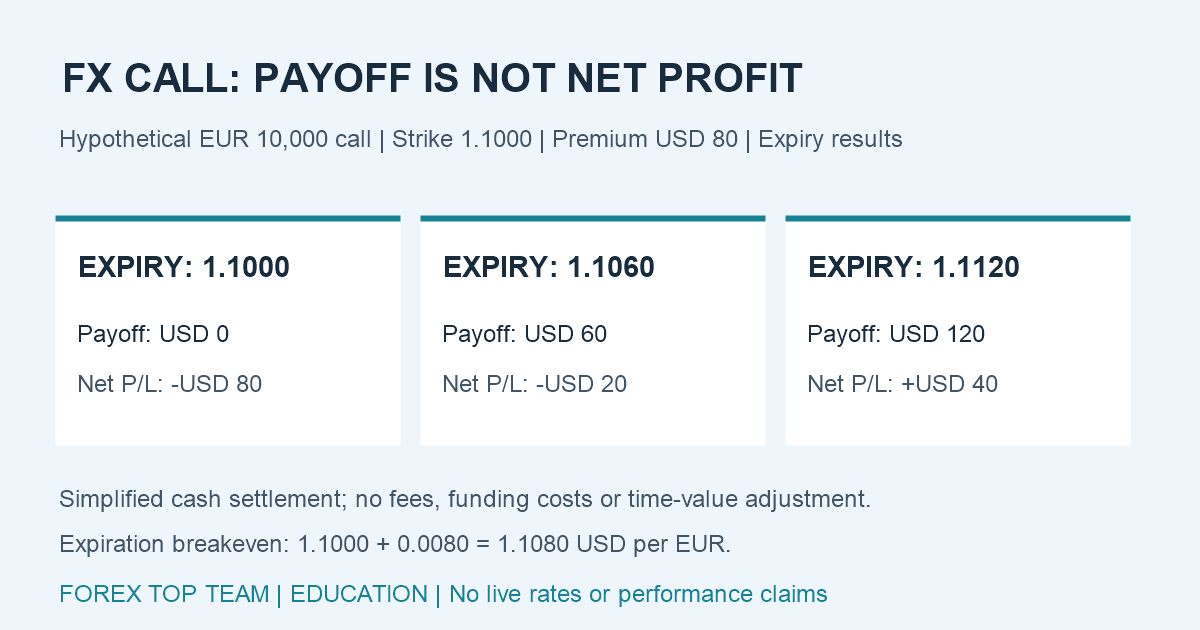
Compare three hypothetical expiry rates:
- At 1.1000: payoff USD 0; net P/L −USD 80.
- At 1.1060: payoff USD 60; net P/L −USD 20.
- At 1.1120: payoff USD 120; net P/L +USD 40.
At 1.1080, the payoff is exactly USD 80 and net P/L is zero. The 0.0080 gap from strike to breakeven equals 80 conventional EUR/USD pips, assuming one pip is 0.0001. It is a cost-recovery distance at expiry, not a forecast of how far the currency will move.
Before expiry, use the option’s sale value
The expiration breakeven is not a requirement that spot must cross before you can close the option profitably. While time remains, its sale value can differ from its eventual expiry payoff.
CME’s options fundamentals distinguishes intrinsic value from time value. Its examples concern options on futures, but the distinction helps explain why an expiration diagram cannot describe every earlier liquidation outcome.
If our hypothetical option can be sold before expiry at an executable bid of 0.0090 USD per EUR, sale proceeds are USD 90. Against an actual USD 80 entry premium, that would be a USD 10 gain before fees, regardless of whether spot has crossed 1.1080. This assumed bid is an illustration, not a model price or available quote.
For the sensitivities behind changing premium, read why an FX call can lose when the pair rises. It separates direction, time and volatility changes.
Add costs and read the actual settlement rules
Suppose total additional charges for holding our example through settlement are a fixed USD 4. The required payoff becomes USD 84. Divide that by EUR 10,000 to get 0.0084 USD per EUR, giving an adjusted breakeven of 1.1084 under the same assumptions.
Do not automatically add a quoted spread again if your premium already uses the actual purchase price and your early-exit scenario uses an executable sale bid. Identify which costs are already reflected in each input.
Real FX products vary. CME’s FX options page specifically covers options on futures and provides contract resources. A spot-referenced cash payoff cannot simply replace a futures contract’s exercise and settlement rules.
Check the precise expiry time and timezone, reference-rate source, premium currency, notional and delivery obligations. If exercise creates another position or requires currency delivery, manage that resulting exposure separately.
Your practical payoff checklist
- Write the underlying, quote direction, strike and notional units.
- Convert the quoted premium into an actual cash payment.
- Calculate gross payoff and net P/L in separate lines.
- Label the breakeven as an expiration calculation with stated cost assumptions.
- Use an executable option bid for an earlier sale scenario.
- Read settlement and exercise procedures before holding into expiry.
For practice, calculate the three expiry outcomes above before looking at their answers. Then add a fee and recalculate the breakeven. The useful habit is keeping the contract’s value separate from the trade’s profit.