A positive interest-rate differential is a source of potential carry, not a complete investment thesis. An unhedged currency position combines exchange-rate exposure, financing cash flows and implementation costs. A professional evaluation separates these components before asking whether the position offers an acceptable return for the risk taken.
This article develops an analytical framework rather than a current market recommendation. All numerical examples are hypothetical; they are not live quotes, broker swap rates or forecasts.
1. Define the exposure before calculating the yield
Suppose an investor borrows currency B and buys an interest-bearing asset denominated in currency A. Let S be the price of one unit of A in units of B, and let rA and rB be comparable annual financing rates. With a one-year holding period, no costs and simple interest, the return on the initial B-currency notional is:
R = (S1 / S0) × (1 + rA) − (1 + rB).
This is a notional return, not a return on margin. It assumes funding remains available and ignores the timing of cash flows. For short horizons and small changes, it is approximately the spot return plus the rate differential. The exact expression also includes an interaction between the exchange-rate move and the interest earned.
In a hypothetical example, rA is 5% and rB is 2%. If A depreciates by 4%, R equals 0.96 × 1.05 − 1.02, or −1.2%. The apparent 3% yield advantage fails to protect the investor against the currency move. Under these assumptions, the break-even S1/S0 ratio is 1.02/1.05, approximately 0.9714: depreciation of about 2.86% exhausts the carry before costs.
2. Forward points are not an independent currency forecast
For S quoted as B per unit of A, the textbook covered-interest-parity relationship is F/S = (1 + rB × T)/(1 + rA × T), using compatible simple rates and year fraction T. Hedging the final A proceeds at this forward rate removes the idealised interest advantage. Actual pricing requires matching value dates, day-count conventions, executable bid/ask prices and funding access.
A forward discount on the higher-yielding currency therefore does not, by itself, mean the market expects that currency to fall by the same amount. The forward is a transaction price shaped by financing and hedging conditions. The BIS analysis of the cross-currency basis explains why hedging demand and balance-sheet constraints can also push forward pricing away from textbook parity. These deviations are not automatically accessible arbitrage profits for a retail account.
3. Replace policy-rate headlines with executable financing
A central-bank rate spread is not the swap credit that a broker will necessarily pay. For a rolling leveraged FX product, obtain the actual long and short financing schedule, the calculation basis, holiday adjustments and the broker’s markup. Translate the cash charge into the account currency and reconcile it against statements. A positive theoretical carry can become negative after implementation costs.
Distinguish financing embedded in a dated forward from financing charged on a rolling position; adding both without examining the contract can double-count costs. Likewise, a large rollover entry around a weekend or holiday may represent several accrual days rather than a sudden improvement in the annual yield.
4. Evaluate risk at the account level
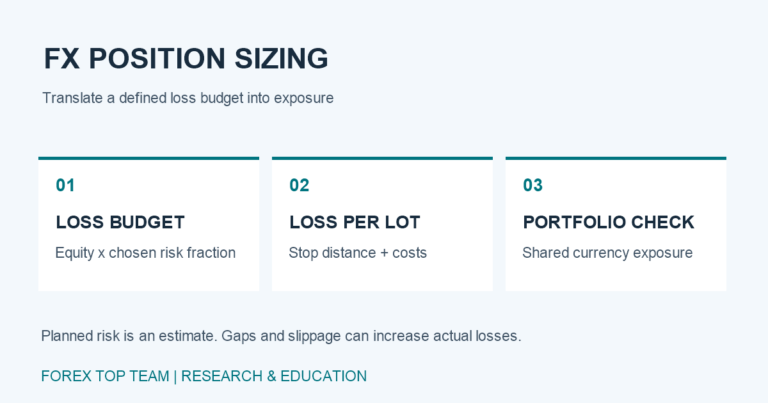
Leverage changes the relationship between a notional loss and account equity. At ten times equity exposure, a 1% adverse notional price move corresponds approximately to a 10% equity loss before financing and other positions. This illustration assumes linear exposure; actual liquidation rules and conversion effects must be checked separately.
Carry analysis should include three explicit scenarios: a gradual currency decline while financing remains favourable; a policy repricing that reduces carry and moves spot against the position; and a liquidity shock that widens spreads while correlated positions unwind. Choose scenario magnitudes from a documented stress methodology, rather than treating a calm recent sample as the maximum possible loss.
A stop order is an execution instruction, not a guaranteed loss ceiling. A gap can produce a fill beyond the requested level. Maintain enough liquidity to meet margin requirements under stressed prices and costs, and assess multiple carry positions as a portfolio: several currency pairs may express the same funding-currency exposure.
5. A practical decision record
- Thesis: identify the expected source of return and the evidence that would invalidate it.
- Financing: record executable terms, value dates, broker charges and account-currency conversions.
- Risk budget: state notional exposure, equity exposure and stressed loss in currency amounts.
- Exit conditions: specify policy, volatility and liquidity developments that trigger reassessment.
- Attribution: separate realised spot P&L, financing and transaction costs after the trade.
The relevant question is whether net carry compensates for currency and liquidity risk within a defined portfolio budget. A high yield alone cannot answer it.
Educational analysis only. Leveraged FX trading can generate substantial losses; the examples above do not establish a suitable position size for any particular investor.