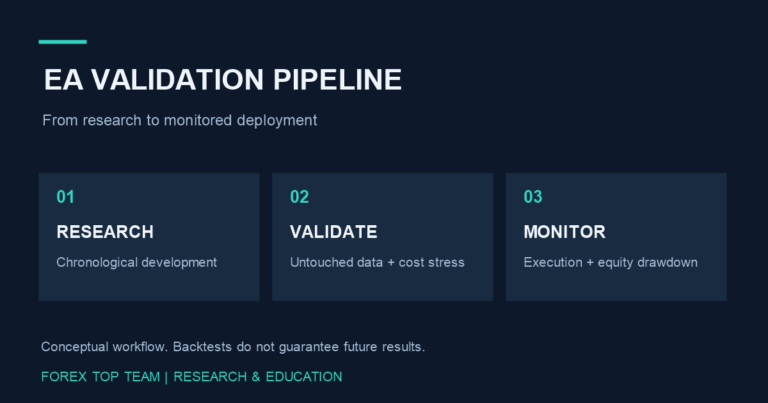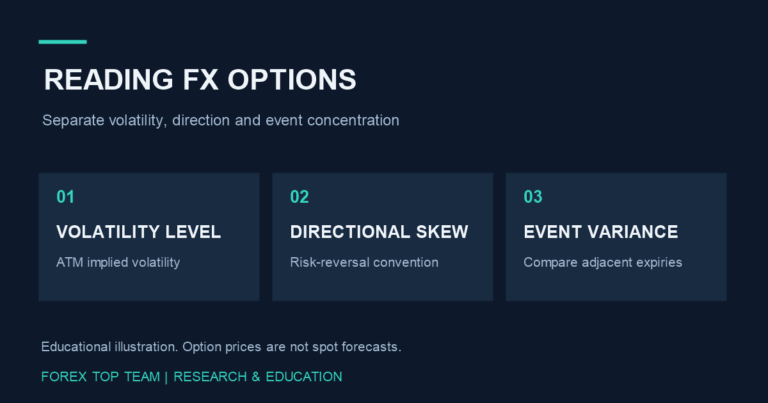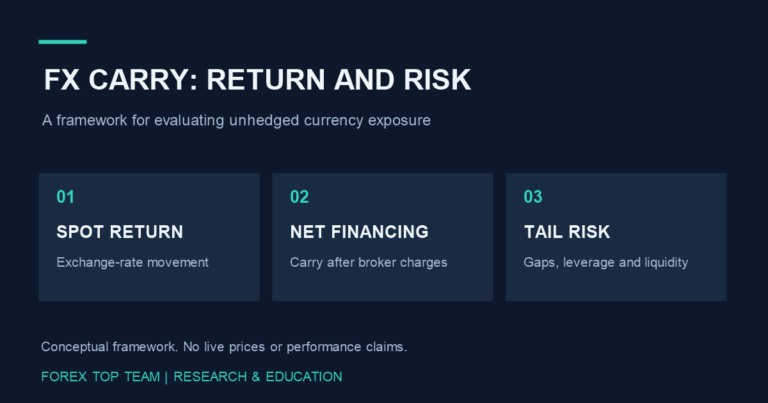
Position sizing translates a trading idea into an exposure that an account can support. A forecast can be directionally correct and still produce an unacceptable loss if the position is too large, financing is overlooked, or several trades depend on the same currency move. A professional sizing process starts with a defined loss budget, converts that budget into trade units, and then checks the combined portfolio.
This framework is educational. Every number below is hypothetical, and the chosen risk fractions illustrate arithmetic rather than recommend a suitable allocation for any investor.
1. Define the budget before selecting the lot size
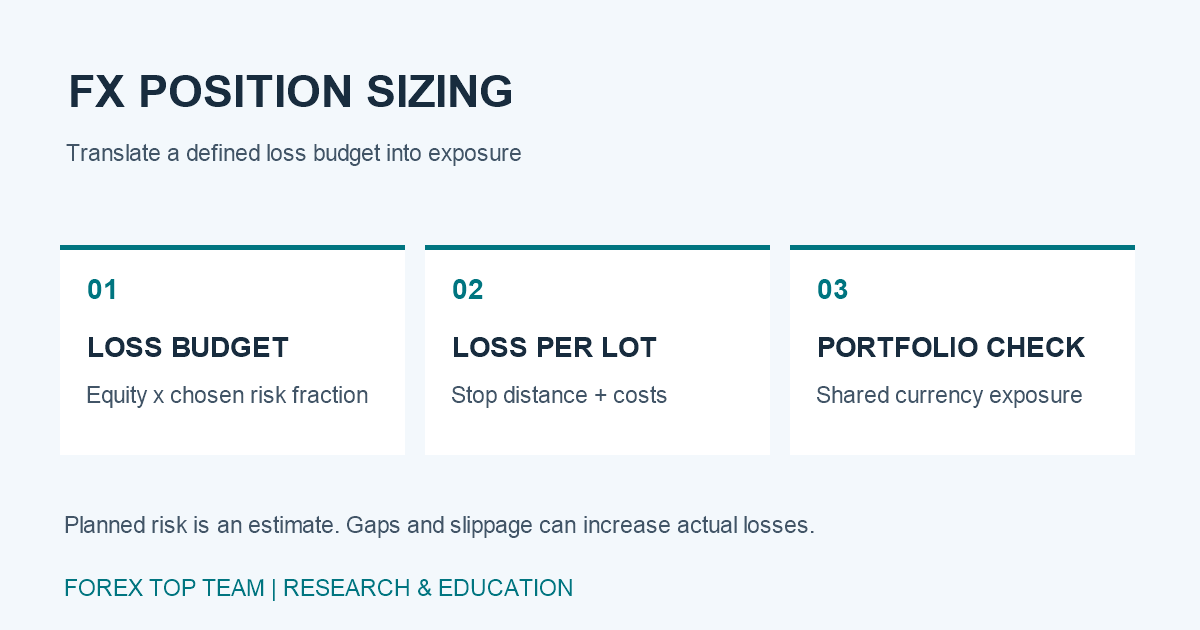
Let E be marked-to-market account equity and f the chosen fraction allocated to a trade’s planned loss. The initial budget is B = E × f. For hypothetical equity of USD 50,000 and f = 0.5%, B is USD 250. Using equity rather than closed-trade balance makes existing floating losses visible, although capital reserved for withdrawals or other obligations may require a stricter base.
The fraction itself is a policy decision. It should reflect loss tolerance, strategy uncertainty, liquidity and portfolio concentration. A standard percentage copied from another account cannot determine suitability. Several trades can each satisfy their individual budget while collectively exceeding the account’s acceptable loss.
CME’s position-size lesson connects a logical stop location with a defined monetary risk allowance. Applied to FX, that principle means the trade’s invalidation logic should help determine the stop distance; the lot size is then calculated around that distance. Moving the stop closer merely to accommodate a larger position changes the strategy.
2. Convert price movement into account-currency loss
For a linear FX position, define d as the distance from the expected executable entry to the assumed exit, in pips, and v as account-currency pip value per lot. With proportional cost allowance c per lot, an estimated loss per lot is L = d × v + c. The provisional size is q = B/L, rounded down to the permitted lot increment.
Suppose EUR/USD has a 100,000-EUR lot, the account is in USD, the pip increment is 0.0001, and the stop distance is 40 pips. Pip value is USD 10 per lot. With an illustrative USD 20 per-lot allowance for additional commission and execution uncertainty, L equals USD 420. A USD 250 budget gives q ≈ 0.5952 lots; with 0.01-lot increments, the rounded size is 0.59 lots and estimated loss is USD 247.80.
Verify the product specification: a broker’s symbol name does not establish its contract size. If costs include a fixed minimum charge per order, solve B ≥ q × L + fixed cost instead of assuming all costs scale proportionally. Recalculate after rounding and include expected financing if the holding period extends across rollover.
3. Treat currency conversion as part of the calculation
The quote currency receives the immediate P&L for a standard linear FX calculation. If it differs from the account currency, convert the loss using a documented conversion rate and stress that rate when appropriate. For a hypothetical 100,000-USD lot of USD/JPY with a 0.01-JPY pip increment, one pip is JPY 1,000. At a hypothetical USD/JPY conversion rate of 150, that is approximately USD 6.67; at 145 it is approximately USD 6.90.
Conversion is therefore not always a constant. An adverse USD/JPY move can simultaneously change the exit loss in yen and the dollar value of that yen loss. For larger scenarios, calculate the full P&L at the scenario rate instead of multiplying today’s pip value by a large number of pips.
CME’s contract P&L guide demonstrates why contract size and minimum price increments matter. Its examples concern futures; spot FX and CFDs require their own specifications, and their quoted prices and settlement rules should not be treated as interchangeable.
4. Avoid double-counting spread and confusing margin with risk
If d already measures the path from an executable ask entry to an executable bid exit for a long trade, spread is embedded in the price loss. Adding the same spread again inflates the estimate. If d is measured from a mid-price chart, an explicit execution adjustment is required. Specify whether the platform triggers stops using bid, ask or another reference.
Required margin is collateral, not the maximum economic loss. A position can meet the broker’s margin requirement while remaining too large for the portfolio budget. Assess free margin under stressed prices, financing charges and conversion rates, rather than treating available leverage as an exposure target.
A stop-loss order does not guarantee the assumed exit. Gaps, thin liquidity and rapid repricing can increase realised loss. Stop-limit orders create a different trade-off: limiting the execution price may leave the order unfilled. Review the exact order terms and model the consequences of both slippage and non-execution.
5. Aggregate currency exposures before relying on diversification
A long EUR/USD position buys EUR and sells USD. A long GBP/USD position buys GBP and sells USD. The instruments differ, but both contain short-USD exposure. Translate every position into its currency legs and account-currency notionals, then examine common drivers such as USD strength, risk sentiment and funding stress.
For a simplified portfolio of linear exposures, variance can be expressed as sigmaP² = wᵀΣw, with signed exposure weights w and a consistently estimated return covariance matrix Σ. This is a model, not a worst-case loss bound. State the sampling interval, observation window and treatment of changing currency conversions. Historical correlations may not describe a future stress period.
Complement the covariance estimate with explicit scenarios: simultaneous USD appreciation against multiple holdings, spread widening at a liquidity transition, and a gap through several stops. Calculate account-currency P&L and stressed margin consumption for the combined book.
6. Maintain a reproducible sizing record
- Record equity, the trade budget and the remaining portfolio budget.
- Document entry and stop conventions, contract size, pip value and conversion rates.
- Separate embedded spread from additional commission, financing and execution allowances.
- Round exposure down, then verify estimated loss and stressed margin.
- Reconcile actual fills and cash flows against the planned estimate after exit.
The CFTC’s forex advisory emphasises the substantial risks of FX and margin trading. A sizing framework improves clarity about exposure; it does not remove market risk or establish a guaranteed loss ceiling. Its value is a consistent, auditable connection between the trade thesis and the capital placed at risk.
Educational analysis only. This article does not recommend a particular leverage level, trade size or financial product. Hypothetical calculations are not live prices or performance results.