
A failed breakout is followed by a larger position in the opposite direction. Price only needs to move a little farther to recover the basket, so why can the account still suffer a large drawdown? The answer sits in the whole sequence of positions. Before approving a BreakoutLogic entry, map how gross exposure, net direction and the recovery distance change after each reversal.
Write down what remains open
The BreakoutLogic method description specifies a first range-breakout entry, followed by opposite positions at a configured adverse distance. Its illustrated defaults use a 25-pip distance, a doubling multiplier and four maximum steps. The basket target is expressed as eight pips of the first position’s lot size. The MT5 version requires a hedging account.
The distinction matters because a hedging account can retain separate buy and sell positions on the same symbol. A netting account aggregates the position differently. MetaTrader explains these accounting systems in its basic trading principles. Check the actual account mode before using an example that assumes earlier positions remain open.
Use a hypothetical EUR/USD contract of 100,000 euros per standard lot and a USD account. One pip is 0.0001 USD per euro, worth USD 10 per pip at one lot and USD 0.10 at 0.01 lot. Assume ideal fills, no spread, commission, financing or slippage, and that no position closes between steps. These assumptions isolate the exposure arithmetic. A live worksheet must replace them with broker specifications and executable bid and ask prices.
Track gross lots and net lots separately
Start with a 0.01-lot buy at 1.1000. At 1.0975, add a 0.02-lot sell. Gross exposure, the sum of all open lots, becomes 0.03 lot. Net exposure, total buy lots minus total sell lots, is minus 0.01 lot. The basket now gains approximately USD 0.10 per pip when EUR/USD falls, before costs.
If price returns to 1.1000, add a 0.04-lot buy. Gross exposure rises to 0.07 lot and net exposure becomes plus 0.03 lot. A subsequent fall to 1.0975 adds a 0.08-lot sell. The four open positions now total 0.15 lot gross, comprising 0.05 buy lots and 0.10 sell lots. Net exposure is minus 0.05 lot.
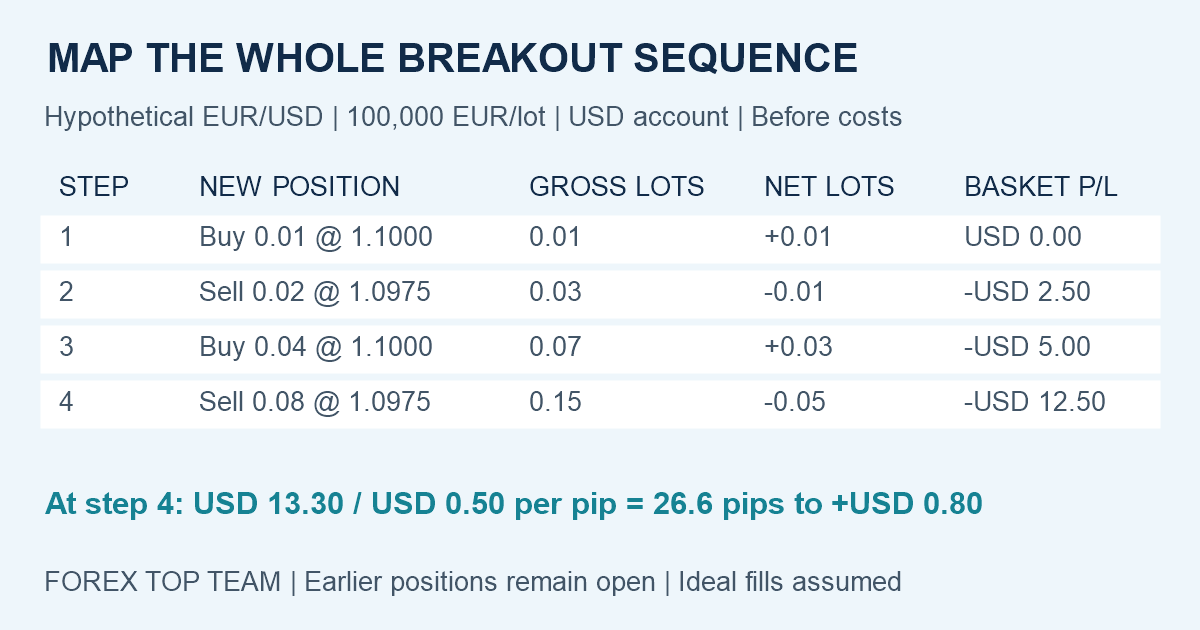
At that fourth entry price, the first buy has lost USD 2.50 and the third-step buy has lost USD 10. Both sells are at their entry prices. The basket therefore stands at minus USD 12.50 before costs. Its net sensitivity is approximately USD 0.50 per pip, favorable when EUR/USD falls. Gross lots remain relevant to execution charges and broker margin treatment even though opposing positions partly offset price sensitivity.
Calculate the recovery distance from the current basket
Eight pips of the first 0.01-lot position equal USD 0.80. To move from minus USD 12.50 to that gross target after the fourth entry, the basket needs USD 13.30 of improvement. Divide by USD 0.50 per pip to get 26.6 pips. Under these assumptions, price must fall from 1.09750 to approximately 1.09484.
Suppose a separate USD 2 charge must also be recovered across the complete sequence. The required improvement becomes USD 15.30, equivalent to 30.6 pips. The exact adjustment depends on when charges are booked and whether the tool’s displayed basket profit already includes them. Reconcile that definition first so costs are counted once.
After the maximum step has been reached, an adverse move still changes the basket’s value. A 40-pip rise from the fourth entry adds roughly USD 20 of loss at the existing net exposure, bringing the hypothetical floating loss to USD 32.50 before costs. A maximum step count limits further additions. Your account also needs a defined action for the exposure already open.
Test the loss rule independently of the recovery target
Build a row for every reachable step showing the entry prices, buy lots, sell lots, floating result, estimated costs, available margin and intended exit action. Apply your chosen cash-loss limit to each row and to adverse paths beyond the last step. A small basket target can be reached frequently while occasional failed sequences dominate the total result.
The product page lists total-lot, margin-level and basket-loss guards, including a default 10% balance loss limit. Treat every setting as something to inspect against your own budget. A configured threshold is an instruction whose execution depends on quotes, order processing and the account state. Record the realized exit result when assessing whether the guard worked as intended.
Margin for offsetting positions depends on the account and symbol settings. MetaTrader’s margin-calculation documentation describes hedged-margin treatment. Check the broker’s specification and the margin impact of the next order before authorizing the sequence. Verify the cash exposure per lot on a cent account as well.
Approve a complete plan
Use the BreakoutLogic Navigator in the Forex Top Team Trading Toolkit to inspect the displayed step plan, combined target and next-step price before allowing the semi-automatic Assist EA to begin. Compare those figures with an independent worksheet. Save the settings and verify the session window against the broker clock, using the process in Why Server Time Matters for Your EA.
For a meaningful historical review, count one complete basket as one opportunity. Record how often each step was reached, the worst floating loss, the exit cost and the final net result. Include unfinished baskets at the review boundary. This makes the recovery mechanism measurable and gives you a concrete basis for accepting, reducing or passing on the next setup.